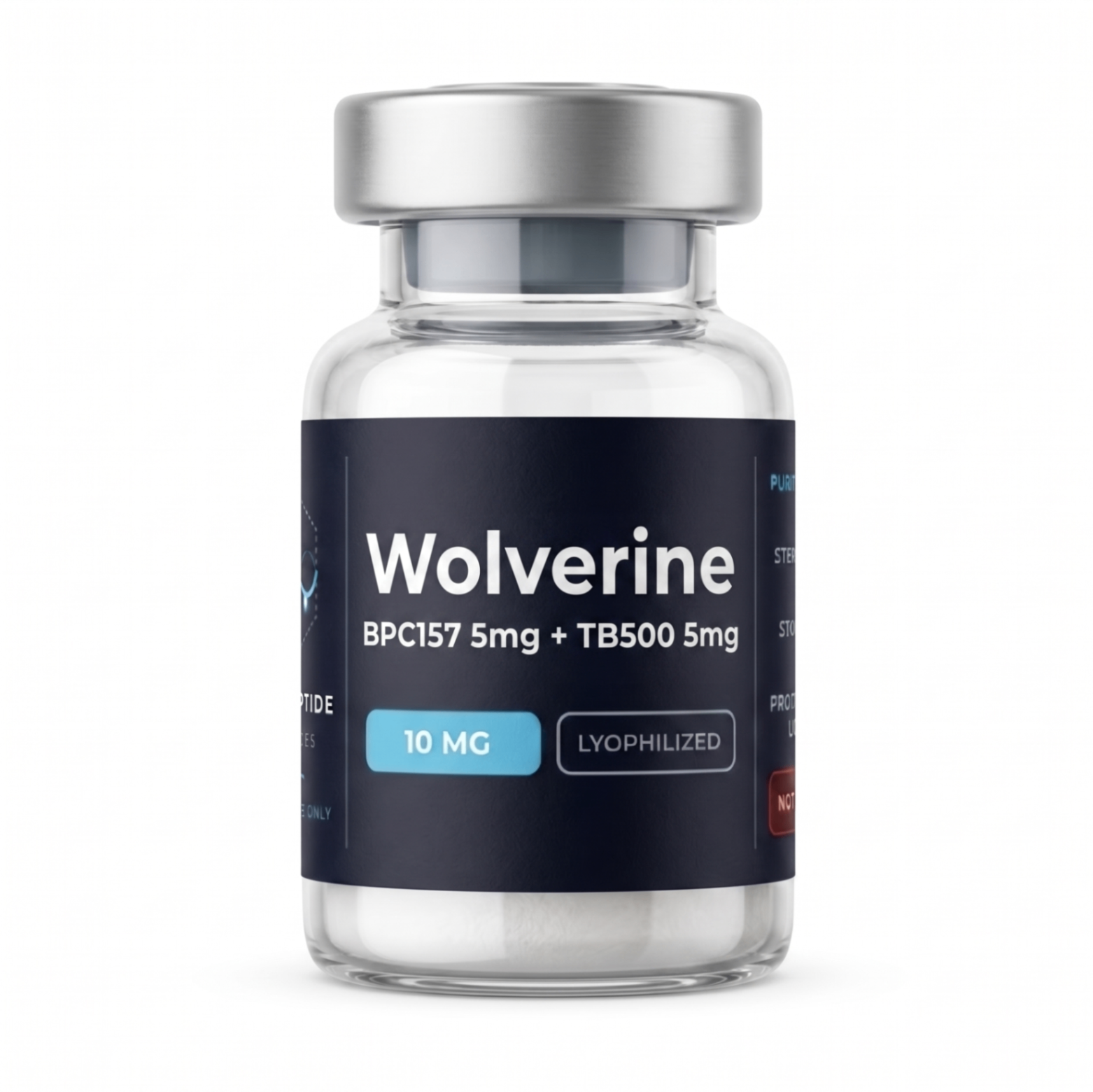
Wolverine
BPC-157 + TB-500 stack. The classic injury-repair pair.
- Delivers strong, fast soft-tissue recovery.
- Built for heavy training blocks.
- Combines multiple repair mechanisms in one shot.
Pre-blended injury-recovery duo: BPC-157 5 mg + TB-500 5 mg in a single vial. The most-used research stack for tendon, ligament, and joint protocols.
Wolverine combines the two most studied repair peptides in a single convenient vial. BPC-157 handles microvascular formation and tendon-to-bone interface; TB-500 supports cell migration into the injury site. Together they are the canonical recovery pair.
- 10.2 mL subcutaneous near the area of interest, daily for 2–4 weeks.
- 2Maintenance: 2–3× weekly. Rotate injection sites.
- Reconstitution
- 2 mL bacteriostatic water into the blended vial → working stock per label.
- Typical research dose
- Reference 0.1–0.2 mL per administration.
- Frequency
- Once daily, subcutaneous — recovery-research framing.
- Vial duration
- A blended vial typically lasts ~20–30 days at 0.1 mL/day and ~10–15 days at 0.2 mL/day — kept inside the 30-day reconstituted-use window.
- Storage
- Refrigerate 2–8 °C; use within 30 days reconstituted.
- BPC-157 / TB-500 stack — defer to the printed lot label for exact mass breakdown.
Understanding Wolverine
Maximum recovery, one vial
Written for people new to peptides. Clear language, careful claims, no dosing instructions.
+What is Wolverine?
Wolverine is a research blend named for its aggressive recovery profile. It typically combines BPC-157, TB-500 and additional repair peptides into one preparation.
Researchers often choose it when stacking BPC-157 and TB-500 individually would be inconvenient.
+How Wolverine was discovered
Wolverine emerged in research-community compounding around the same time as KLOW and GLOW — named for the comic-book character and his rapid-recovery trope. It is the recovery-weighted relative of the two: heavier on BPC-157 and TB-500 than on cosmetic peptides.
+How Wolverine works in the body
- Combines the angiogenic, fibroblast-supporting and cell-migration effects of BPC-157 and TB-500-class peptides in one vial.
- The result is a broad, layered push on tissue repair pathways — vascular, structural, and inflammatory.
+Benefits
- Delivers strong, fast soft-tissue recovery.
- Built for heavy training blocks.
- Combines multiple repair mechanisms in one shot.
+Research highlights
Component peptides have their own research base. The blend is a research-community format, not a formally-studied product, so the individual-component literature is the relevant reference.
+What researchers commonly report
Researchers commonly report durable improvements in chronic tendon and joint complaints when running this blend across a multi-week protocol.
+Why researchers find Wolverine interesting
Wolverine is interesting as a 'maximum recovery stack' format — most of the dose by mass is BPC-157 and TB-500, so the blend is closer to a co-administration than to a true four-peptide mix.
+Quality markers we look for
- HPLC purity reviewed with a target of ≥99%
- Mass spectrometry identity confirmation
- LAL endotoxin screening on applicable batches
- Lyophilized (freeze-dried) format for stability
- Careful storage and handling — keep cold, reconstitute with sterile water
+Often paired with
The data your lab notebook needs.
Pulled from the verification packet included with each shipment. Cross-check the batch ID on your vial against the COA.
- Composition
- BPC-157 5 mg · TB-500 5 mg
- Total Mass
- 10 mg per vial
- Purity
- 99%+ HPLC per component
- Application
- Injury & tendon recovery research
- Purity
- Not yet published
- Source
- Not yet published
- Storage
- Lyophilized: 2–8 °C. Reconstituted: 2–8 °C, use within 30 days.
- Reconstitution
- Add 2 mL bacteriostatic water to the blend vial.
- Half-life
- BPC-157 ~4 h; TB-500 ~2 h plasma