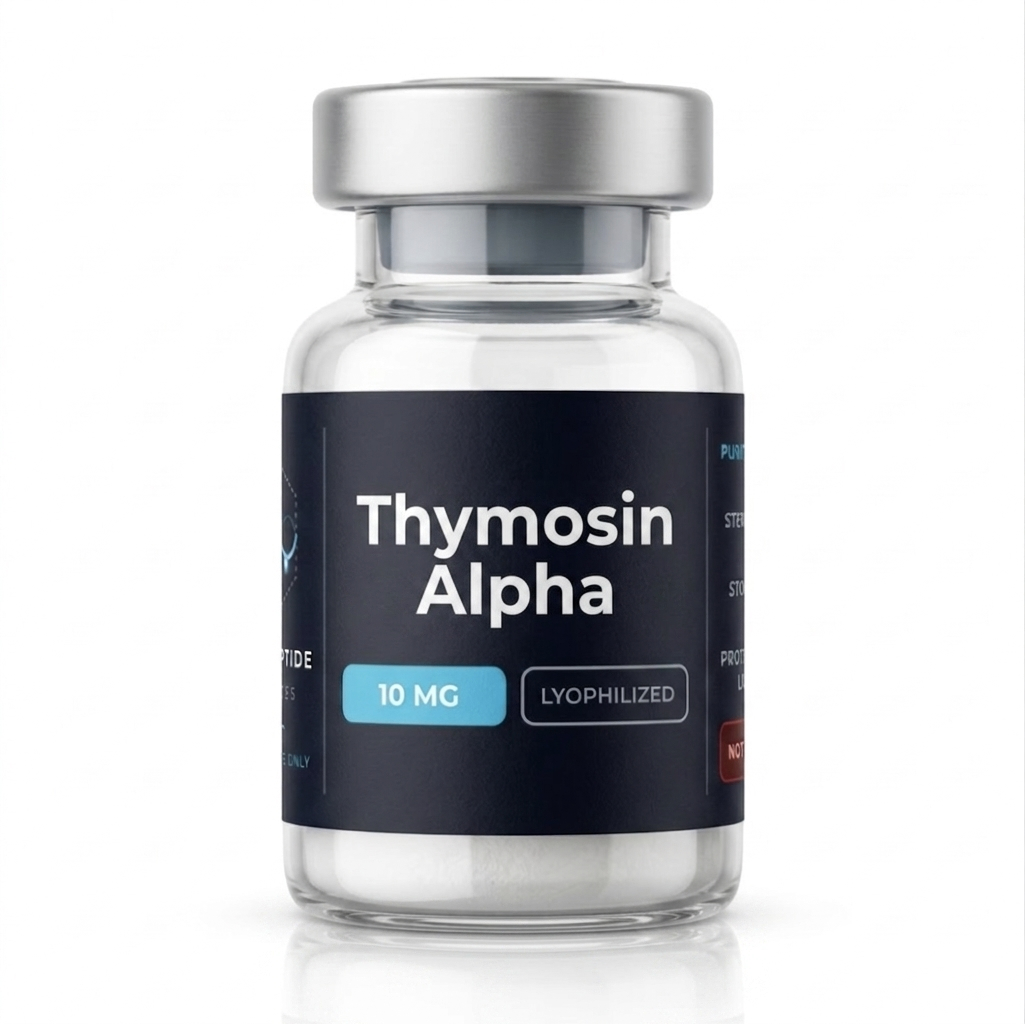
Thymosin Alpha-1
28-amino-acid thymic peptide. Immune modulation and antiviral research.
- Strengthens your immune system's ability to detect threats.
- Supports resilience during infection and illness.
- Helps you stay resilient through hard training or travel.
- Calms inflammation while boosting immunity.
Synthetic version of the natural thymic peptide. Used clinically (Zadaxin) for hepatitis B and immune restoration in oncology.
Thymosin Alpha-1 enhances T-cell differentiation and natural-killer cell activity. Approved in over 30 countries for chronic hepatitis B and adjuvant cancer therapy.
- 11.6 mg subcutaneous, twice weekly.
- 2Cycle: 8–12 weeks.
- Reconstitution
- 5 mL bacteriostatic water into a 10 mg vial → 2 mg/mL (each 0.8 mL = 1.6 mg).
- Typical research dose
- Clinical reference 1.6 mg twice weekly.
- Frequency
- Twice weekly, subcutaneous.
- Vial duration
- A 10 mg vial covers ~3 weeks at 1.6 mg twice weekly (3.2 mg/week) — inside the 30-day reconstituted-use window.
- Storage
- Refrigerate 2–8 °C; use within 30 days reconstituted.
Understanding Thymosin Alpha-1
Balances and strengthens your immune system
Written for people new to peptides. Clear language, careful claims, no dosing instructions.
+What is Thymosin Alpha-1?
Thymosin Alpha-1 is a 28-amino-acid peptide originally isolated from the thymus, the organ that trains your T-cells. It is one of the most clinically-used immune-balancing peptides in the world.
It is approved for clinical use in many countries (Zadaxin) for hepatitis B and as an immune-support adjunct in cancer care, infections, and severe sepsis.
+How Thymosin Alpha-1 was discovered
Thymosin Alpha-1 was first isolated by Allan Goldstein in 1972 from calf thymus extracts. It was synthesized in 1977 and developed commercially as Zadaxin (SciClone Pharmaceuticals), which is approved in dozens of countries for hepatitis B and as an immune-support adjunct in cancer care.
It is one of the few peptides with decades of formal clinical use outside the US — making it one of the better-characterized immune peptides in the catalog.
+How Thymosin Alpha-1 works in the body
- Thymosin Alpha-1 acts through TLR (Toll-like receptor) signaling — primarily TLR2 and TLR9 — on dendritic cells and supports the maturation and balance of T-cell populations.
- The net effect in research is improved immune surveillance, better antiviral response, and a more balanced inflammatory profile — boosting under-responsive immunity while damping over-active inflammation.
- It also influences regulatory T-cell populations, which is part of why it has been studied as an immune adjunct rather than a pure stimulant.
+Benefits
- Strengthens your immune system's ability to detect threats.
- Supports resilience during infection and illness.
- Helps you stay resilient through hard training or travel.
- Calms inflammation while boosting immunity.
+Research highlights
Thymosin Alpha-1 has decades of clinical evidence across hepatitis B and C, immune adjunct in cancer care, vaccine-response augmentation, and sepsis (notably studied during the COVID-19 pandemic).
Main research areas: viral hepatitis, oncology immune adjunct, sepsis, and age-related immune decline ('immunosenescence').
It is one of the few peptides whose 'balance both directions' effect on the immune system is well documented — most immune peptides only push one way.
+What researchers commonly report
Researchers commonly describe fewer minor infections, faster recovery from illness, and steadier energy during stressful periods.
+Why researchers find Thymosin Alpha-1 interesting
Thymosin Alpha-1 is interesting because it both raises immune response when it is too low and damps it when it is too high — a true 'balancer' rather than a stimulant or suppressant. That two-way behavior is rare and well documented.
+Quality markers we look for
- HPLC purity reviewed with a target of ≥99%
- Mass spectrometry identity confirmation
- LAL endotoxin screening on applicable batches
- Lyophilized (freeze-dried) format for stability
- Careful storage and handling — keep cold, reconstitute with sterile water
+Often paired with
The data your lab notebook needs.
Pulled from the verification packet included with each shipment. Cross-check the batch ID on your vial against the COA.
- Molecular Weight
- 3108.27 g/mol
- Sequence Length
- 28 amino acids
- CAS Number
- 62304-98-7
- Synonyms
- Tα1, Zadaxin
- Purity
- 99%+
- Source
- Synthetic
- Storage
- Lyophilized: 2–8 °C. Reconstituted: 2–8 °C, use within 30 days.
- Reconstitution
- Add 2 mL bacteriostatic water to the 10 mg vial. Each 0.32 mL = 1.6 mg.
- Half-life
- ~2 hours