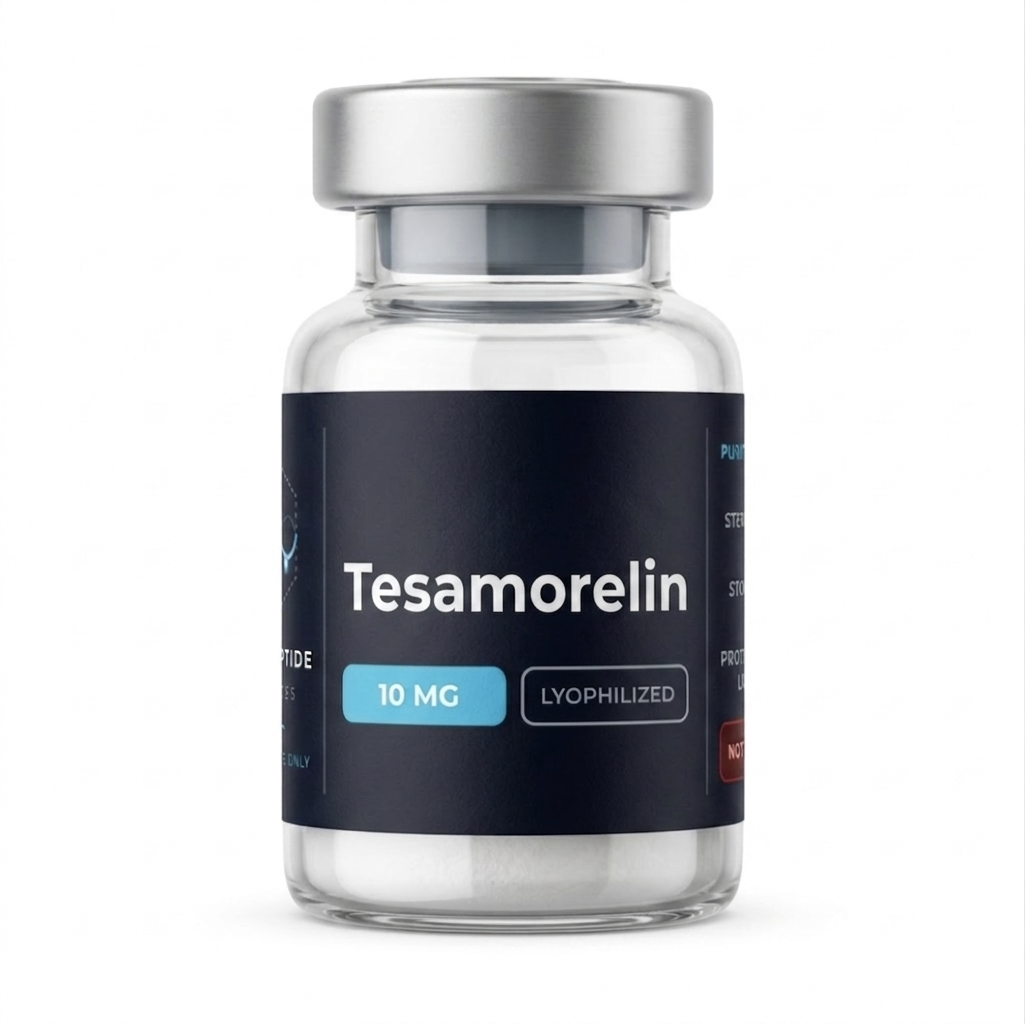
Tesamorelin
GHRH analog with selective visceral-fat reduction.
- Shrinks visceral fat — the deep belly fat around your organs.
- Improves cholesterol and waist size.
- Helps preserve lean muscle when paired with training.
- Improves sleep quality.
Stabilized 44-amino-acid GHRH analog approved for HIV-associated lipodystrophy. Pulls down visceral adipose tissue measurably on CT imaging.
Tesamorelin is GRF(1-44) with an N-terminal hexenoyl group that resists DPP-4 cleavage. It restores pulsatile GH release and selectively reduces visceral fat with minimal subcutaneous-fat effect.
- 11–2 mg subcutaneous, once daily before sleep.
- 2Cycle: 12 weeks on, 4 weeks off.
- Reconstitution
- 2 mL bacteriostatic water into a 10 mg vial → 5 mg/mL (each 0.04 mL = 200 mcg).
- Typical research dose
- Commonly referenced at 1–2 mg per day, subcutaneous.
- Frequency
- Once daily, subcutaneous — evening administration commonly used.
- Vial duration
- A 10 mg vial covers ~10 days at 1 mg/day and ~5 days at 2 mg/day — both fit inside the 14-day reconstituted-use window with margin.
- Storage
- Refrigerate 2–8 °C after reconstitution; use within 14 days for peak potency.
Understanding Tesamorelin
Targets stubborn visceral belly fat
Written for people new to peptides. Clear language, careful claims, no dosing instructions.
+What is Tesamorelin?
Tesamorelin is a stabilized analogue of GHRH — the hypothalamic hormone that tells the pituitary to release growth hormone. A trans-3-hexenoic-acid modification protects it from being broken down so a single daily dose can produce a meaningful pulse.
Because it works through your own pituitary, the GH pulse it produces follows a natural rhythm rather than being a flat dose from outside the body — researchers often choose it when they want to support the GH signaling chain without the above-normal peaks of recombinant HGH.
+How Tesamorelin was discovered
Tesamorelin was developed by Theratechnologies and approved by the FDA in 2010 (brand name Egrifta) for reducing visceral fat in HIV-associated lipodystrophy. It remains the only GHRH-class molecule with a formal regulatory approval for a fat-distribution endpoint.
Researcher interest broadened over the following decade as investigators noticed its visceral-fat effect was meaningful in non-HIV populations too — putting tesamorelin at the center of healthy-aging and metabolic research stacks.
+How Tesamorelin works in the body
- Tesamorelin binds GHRH receptors in the anterior pituitary and triggers a pulse of the body's own growth hormone.
- That GH pulse stimulates the liver to produce IGF-1, which mediates many of the downstream effects on lean tissue and fat metabolism.
- The molecule is particularly associated with reductions in visceral adipose tissue (VAT) — the deep belly fat around organs that is most metabolically harmful — and the effect appears to be specific to VAT rather than subcutaneous fat.
+Benefits
- Shrinks visceral fat — the deep belly fat around your organs.
- Improves cholesterol and waist size.
- Helps preserve lean muscle when paired with training.
- Improves sleep quality.
+Research highlights
Tesamorelin has the clearest visceral-fat evidence in the GHRH class, with controlled studies in HIV-associated lipodystrophy showing ~15–20% reductions in visceral fat over 26 weeks.
Ongoing research areas include MASLD/MASH (liver-fat reduction has been shown in randomized trials), cognitive endpoints in healthy older adults, and body-composition studies in non-HIV populations.
Compared with HGH it produces a pulsatile rather than flat GH profile, which is why investigators interested in supporting the GH signaling chain naturally reach for it instead of recombinant somatropin.
+What researchers commonly report
Researchers commonly describe a slower, steadier change in waist measurement compared with incretin-class peptides, with improved sleep and recovery as secondary effects. Mild injection-site reactions are sometimes noted.
+Why researchers find Tesamorelin interesting
Tesamorelin sits in an unusual position — a regulatory-approved peptide for a fat-distribution endpoint, with a mechanism that supports the body's own GH rhythm. It is the cleanest tool the literature has for studying visceral-fat biology specifically.
+Quality markers we look for
- HPLC purity reviewed with a target of ≥99%
- Mass spectrometry identity confirmation
- LAL endotoxin screening on applicable batches
- Lyophilized (freeze-dried) format for stability
- Careful storage and handling — keep cold, reconstitute with sterile water
+Often paired with
The data your lab notebook needs.
Pulled from the verification packet included with each shipment. Cross-check the batch ID on your vial against the COA.
- Molecular Weight
- 5135.83 g/mol
- Sequence Length
- 44 amino acids
- CAS Number
- 218949-48-5
- Synonyms
- TH9507, Egrifta
- Purity
- 99%+
- Source
- Synthetic
- Storage
- Lyophilized: 2–8 °C, protect from light. Reconstituted: 2–8 °C, use within 30 days.
- Reconstitution
- Add 2 mL bacteriostatic water to the 10 mg vial. Each 0.2 mL = 1 mg.
- Half-life
- ~25–40 minutes