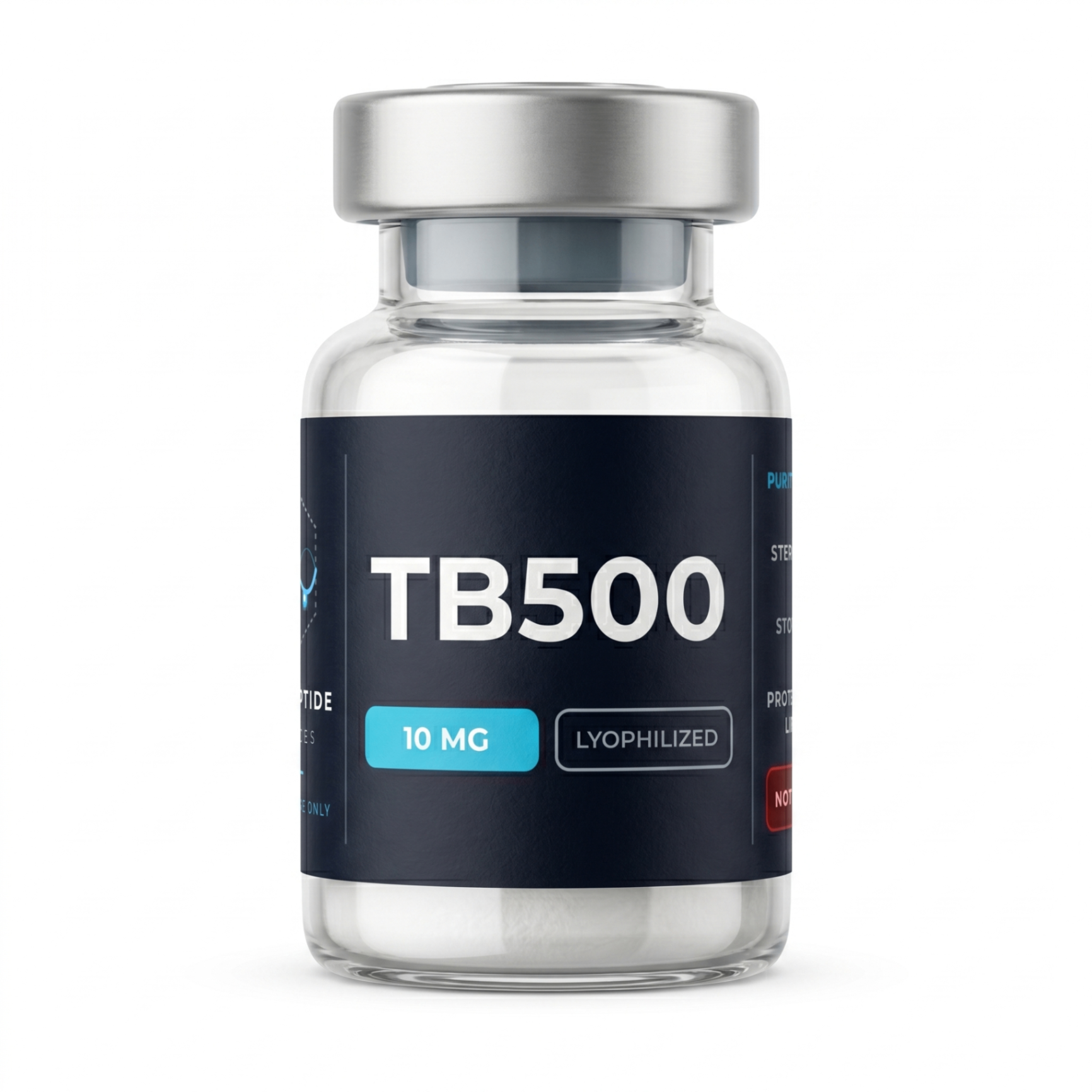
TB-500
Thymosin Beta-4 fragment. Soft-tissue mobility and repair.
- Speeds repair of soft tissue, tendons, and ligaments.
- Supports heart and muscle recovery.
- Reduces inflammation at injury sites.
- Pairs perfectly with BPC-157 for tougher recovery.
Synthetic active region of Thymosin Beta-4. Mobilizes stem cells and regulates actin sequestration.
TB-500 corresponds to the active region of Thymosin Beta-4. Binds G-actin and modulates cytoskeletal dynamics for endothelial and stem-cell migration. Often stacked with BPC-157.
- 1Loading: 2.5 mg subcutaneous, twice weekly for 4 weeks.
- 2Maintenance: 2.5 mg once weekly for 4–8 weeks.
- 3Rotate injection sites.
- Reconstitution
- 2 mL bacteriostatic water into a 10 mg vial → 5 mg/mL.
- Typical research dose
- Loading reference ~2–2.5 mg twice weekly for 4–6 weeks, then ~2 mg weekly maintenance.
- Frequency
- Twice weekly during loading; once weekly maintenance.
- Vial duration
- A 10 mg vial covers ~2 weeks of loading (4 × 2.5 mg) or ~5 weeks of maintenance (5 × 2 mg) — at the maintenance edge, split the vial into two reconstitutions (5 mg each) so each prep finishes within the 30-day storage cap.
- Storage
- Refrigerate 2–8 °C; use within 30 days reconstituted.
Understanding TB-500
Fast, full-body tissue repair
Written for people new to peptides. Clear language, careful claims, no dosing instructions.
+What is TB-500?
TB-500 is the active region of Thymosin Beta-4, a naturally occurring repair protein found throughout the body and concentrated at sites of injury.
It is widely paired with BPC-157 because the two peptides hit different but complementary parts of the tissue-repair process — TB-500 leans on cell migration and remodeling, BPC-157 on vascularization and gut/connective-tissue repair.
+How TB-500 was discovered
Thymosin Beta-4 was first isolated in the 1980s from the thymus. TB-500 — the active 17-amino-acid actin-binding region — was developed as a synthetic research tool that captures most of TB-4's repair activity in a much easier molecule to manufacture.
It became widely known in equine and animal sports-medicine research before crossing into human soft-tissue research, where it now sits alongside BPC-157 as the canonical recovery peptide.
+How TB-500 works in the body
- TB-500 binds to G-actin and regulates how cells reorganize their internal scaffolding — a key step in cell migration to injury sites.
- It supports new blood-vessel formation, adjusts inflammation, and encourages stem cells to move into damaged tissue and mature into the cell types needed for repair.
- It also upregulates the actin-related genes that govern wound-edge closure, which is why dermal and corneal-healing research has been so productive with TB-4 / TB-500.
+Benefits
- Speeds repair of soft tissue, tendons, and ligaments.
- Supports heart and muscle recovery.
- Reduces inflammation at injury sites.
- Pairs perfectly with BPC-157 for tougher recovery.
+Research highlights
TB-500 / Thymosin Beta-4 has been studied for wound healing, cardiac repair after infarct, ocular injury (a TB-4 eye-drop reached Phase 3 for dry eye), and dermal ulcer healing.
Active research interest includes neurological recovery (stroke and traumatic brain injury models) and chronic non-healing wounds.
Compared with BPC-157 the onset of effect is typically slower but more durable — which is why the two are so often run together rather than chosen between.
+What researchers commonly report
Researchers commonly describe a slower-onset but durable effect on chronic soft-tissue issues, especially when combined with BPC-157. Loading phases are widely used because of the slow onset.
+Why researchers find TB-500 interesting
TB-500 is one of the few peptides whose mechanism is rooted in the cell's own structural scaffolding — a totally different angle from receptor-binding peptides. That makes it an unusual research tool for asking how cells physically rebuild damaged tissue.
+Quality markers we look for
- HPLC purity reviewed with a target of ≥99%
- Mass spectrometry identity confirmation
- LAL endotoxin screening on applicable batches
- Lyophilized (freeze-dried) format for stability
- Careful storage and handling — keep cold, reconstitute with sterile water
+Often paired with
The data your lab notebook needs.
Pulled from the verification packet included with each shipment. Cross-check the batch ID on your vial against the COA.
- Molecular Weight
- 4963.44 g/mol
- Sequence Length
- 43 amino acids (Tβ4 1-43)
- CAS Number
- 77591-33-4
- Synonyms
- Thymosin Beta-4 fragment
- Purity
- 99%+
- Source
- Synthetic
- Storage
- Lyophilized: 2–8 °C. Reconstituted: 2–8 °C, use within 30 days.
- Reconstitution
- Add 2 mL bacteriostatic water to the 10 mg vial. Each 0.5 mL = 2.5 mg.
- Half-life
- ~2 hours plasma; tissue effects days