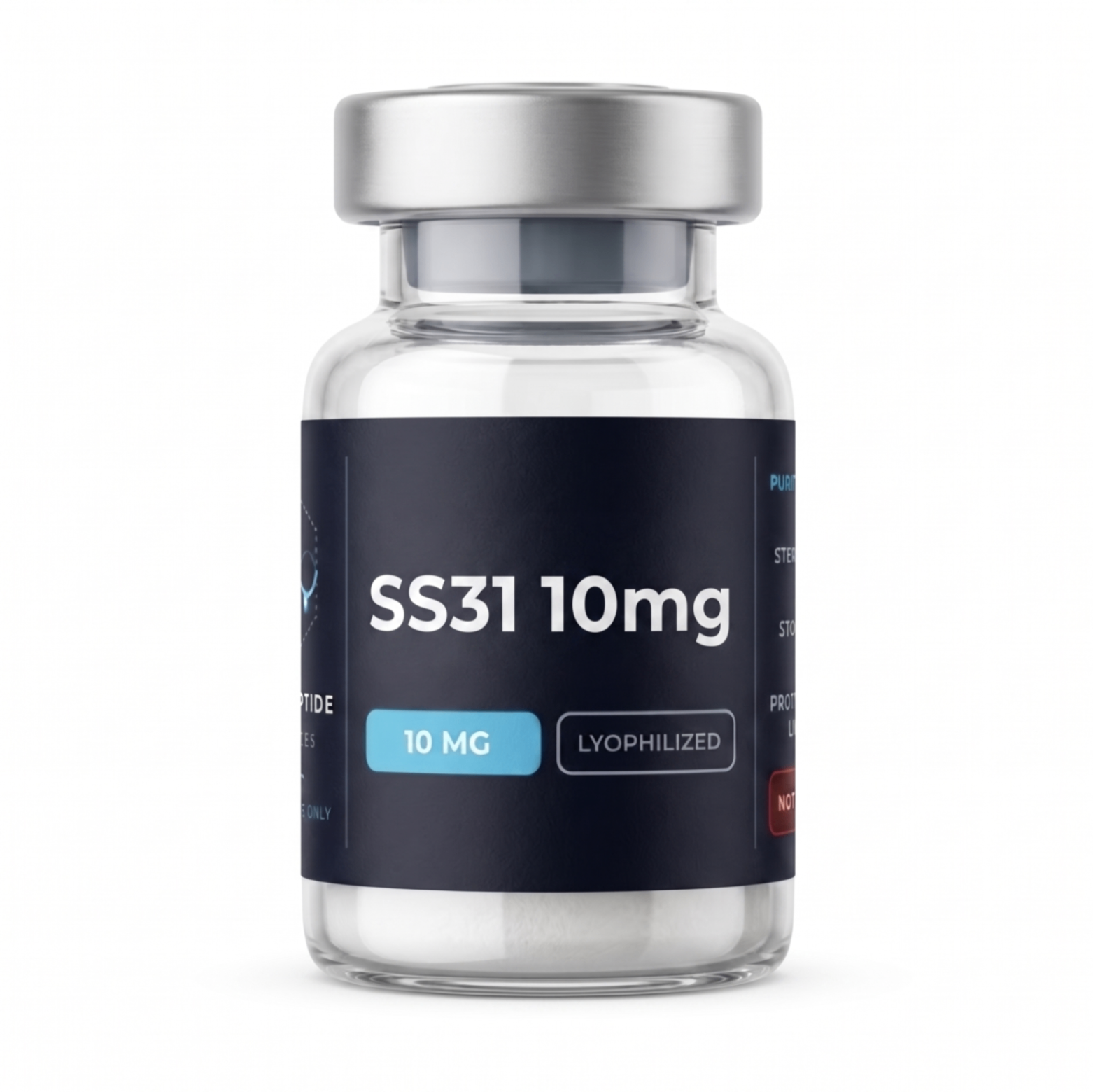
SS-31
Mitochondria-targeted tetrapeptide. Cardiolipin stabilization.
- Boosts mitochondrial energy output.
- Cuts oxidative stress right at the source.
- Supports heart, brain, and healthy aging.
- Speeds recovery from exercise fatigue.
Cell-permeable peptide that selectively binds inner-mitochondrial-membrane cardiolipin. Restores cristae structure and reduces ROS.
SS-31 (Elamipretide) is studied in mitochondrial myopathy, heart failure with preserved ejection fraction, and age-related mitochondrial dysfunction.
- 12–5 mg subcutaneous, once daily.
- 2Cycle: 4–8 weeks on, 4 weeks off.
- Reconstitution
- 2 mL bacteriostatic water into a 10 mg vial → 5 mg/mL (each 0.2 mL = 1 mg).
- Typical research dose
- Research reference 1–5 mg per day SC.
- Frequency
- Once daily, subcutaneous.
- Vial duration
- A 10 mg vial covers ~2 days at 5 mg/day and ~10 days at 1 mg/day — both inside the 30-day reconstituted-use window.
- Storage
- Refrigerate 2–8 °C; use within 30 days reconstituted.
Understanding SS-31
Protects your mitochondria at the source
Written for people new to peptides. Clear language, careful claims, no dosing instructions.
+What is SS-31?
SS-31 — also known as Elamipretide — is a short peptide engineered to selectively accumulate inside mitochondria, where it binds to cardiolipin in the inner membrane.
It is one of the most targeted molecules in mitochondrial medicine, with clinical research across cardiac, neurological and rare-disease applications.
Unlike most peptides it concentrates ~1000-fold inside mitochondria vs. the cytoplasm, which is what makes its mechanism so specific.
+How SS-31 was discovered
SS-31 (Elamipretide, also called MTP-131 or Bendavia) was developed by Hazel Szeto's group at Weill Cornell in the early 2000s — part of a series of 'Szeto-Schiller' peptides engineered to accumulate selectively inside mitochondria.
It has since become one of the most-studied mitochondrial-targeted therapeutics, with completed and ongoing clinical trials in cardiac, neurological and rare mitochondrial-disease settings under Stealth BioTherapeutics.
+How SS-31 works in the body
- SS-31 binds cardiolipin and stabilizes the inner mitochondrial membrane, which is critical for the electron-transport chain to produce ATP efficiently.
- By stabilizing this structure, SS-31 reduces reactive oxygen species production and supports ATP output, especially in stressed or aged mitochondria.
- It also preserves cristae architecture (the folded inner-membrane structure) — when cristae break down, mitochondria stop making energy efficiently, which is a hallmark of age-related decline.
+Benefits
- Boosts mitochondrial energy output.
- Cuts oxidative stress right at the source.
- Supports heart, brain, and healthy aging.
- Speeds recovery from exercise fatigue.
+Research highlights
SS-31 has been studied in clinical trials for heart failure, ischemia-reperfusion injury, Barth syndrome (a rare cardiolipin disorder), and primary mitochondrial disease.
Main research areas: cardiac energetics, age-related skeletal-muscle decline, dry age-related macular degeneration, and neurodegeneration models.
It is one of the only molecules that targets mitochondria physically rather than via signaling — which makes it conceptually distinct from MOTS-c or NAD+.
+What researchers commonly report
Improved energy, reduced subjective fatigue, and faster recovery from physical effort are common reports.
+Why researchers find SS-31 interesting
SS-31 is interesting as a 'membrane medicine' — instead of binding a receptor or providing a cofactor, it physically stabilizes the structure mitochondria depend on. That is an unusual mechanism for a research peptide.
+Quality markers we look for
- HPLC purity reviewed with a target of ≥99%
- Mass spectrometry identity confirmation
- LAL endotoxin screening on applicable batches
- Lyophilized (freeze-dried) format for stability
- Careful storage and handling — keep cold, reconstitute with sterile water
+Often paired with
The data your lab notebook needs.
Pulled from the verification packet included with each shipment. Cross-check the batch ID on your vial against the COA.
- Molecular Weight
- 639.79 g/mol
- Sequence
- D-Arg-2',6'-Dmt-Lys-Phe-NH2 (4 AA)
- CAS Number
- 736992-21-5
- Synonyms
- Elamipretide, MTP-131, Bendavia
- Purity
- 99%+
- Source
- Synthetic
- Storage
- Lyophilized: 2–8 °C, protect from light. Reconstituted: 2–8 °C, use within 14 days.
- Reconstitution
- Add 2 mL bacteriostatic water to the 10 mg vial. Each 0.4 mL = 2 mg.
- Half-life
- ~3–6 hours