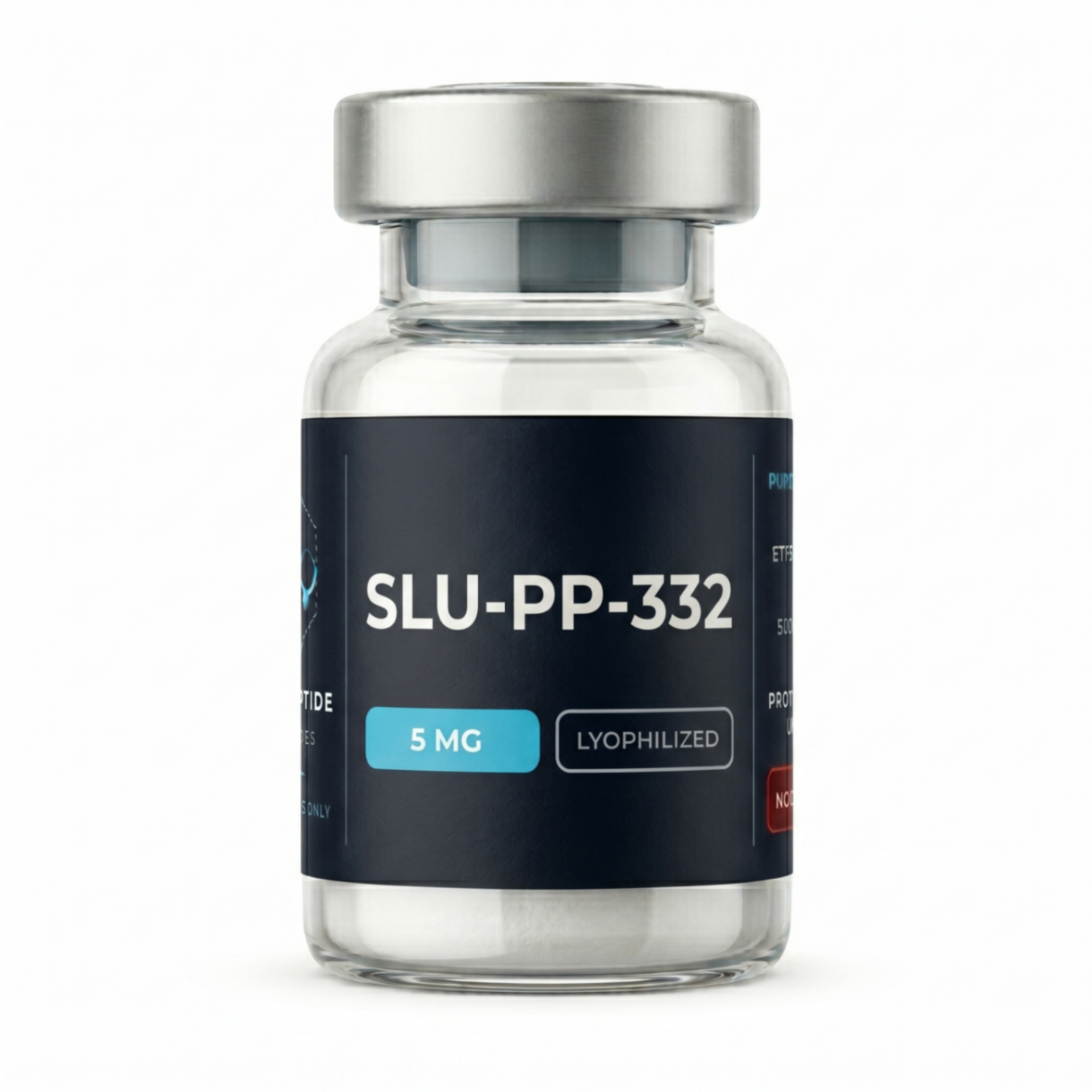
SLU-PP-332
Pan-ERR agonist. Exercise-mimetic small molecule.
- Boosts endurance and resistance to fatigue.
- Increases fat burning and metabolic rate.
- Improves blood sugar control without cutting appetite.
Small-molecule pan-agonist of the Estrogen-Related Receptors (ERRα/β/γ). In mouse studies it increased running endurance and reduced adiposity without exercise.
SLU-PP-332 directly activates the ERR family of nuclear receptors, the master regulators of mitochondrial biogenesis and oxidative metabolism. Treated mice showed roughly 70% improvement in endurance and significant fat-mass reduction at fixed caloric intake.
- 10.5–1 mg subcutaneous, once daily.
- 2Cycle: 4–8 weeks on, 4 weeks off. Refer to source literature for dose-finding context.
- Reconstitution
- Solvent-dependent — commonly dissolved in a DMSO / bacteriostatic water blend for in-vitro research. 1 mL into a 5 mg vial → 5 mg/mL working stock.
- Typical research dose
- Rodent-model research has used ~10–25 mg/kg; no validated human reference dose exists.
- Frequency
- Per protocol — typically daily in animal studies.
- Vial duration
- Use entirely within the research session; reconstituted aliquots are not long-term stable.
- Storage
- Freeze aliquots at −20 °C for short-term storage; avoid repeat freeze-thaw.
- Pre-clinical compound — use only as an investigational reference standard.
Understanding SLU-PP-332
Exercise in a vial
Written for people new to peptides. Clear language, careful claims, no dosing instructions.
+What is SLU-PP-332?
SLU-PP-332 is a small-molecule research compound — not a peptide — that switches on a group of proteins called ERR receptors. These proteins act like a control switch for how muscle responds to endurance training, like running or cycling.
It's often called an 'exercise mimetic' because it turns on many of the same genes that endurance training turns on — without the person actually exercising.
It is strictly a research-only compound so far, with no human safety or dosing data available.
+How SLU-PP-332 was discovered
SLU-PP-332 was reported in 2023 by a Saint Louis University research group as the first selective small molecule to act on all three ERR receptors at once. It became one of the most-discussed 'exercise in a pill' candidates in metabolic research within months of publication.
The compound is named after the lab and the chemical-series number — the public Science paper from the Burris group is the original reference still cited today.
+How SLU-PP-332 works in the body
- Switching on ERR receptors tells muscle cells to build more of their energy-producing mitochondria, burn more fat for fuel, and shift toward the muscle-fiber type used in endurance activity — the same changes endurance training produces naturally.
- In research models this shows up as more energy burned overall, better exercise capacity, and a shift toward burning fat even while at rest.
- Because it works upstream of the cell's energy-producing machinery, its effects look more like 'a body that's been training' than 'a body eating less'.
+Benefits
- Boosts endurance and resistance to fatigue.
- Increases fat burning and metabolic rate.
- Improves blood sugar control without cutting appetite.
+Research highlights
Published mouse work showed SLU-PP-332 roughly doubled running endurance and produced metabolic improvements without affecting food intake — a pattern that does not exist in any approved drug class.
It is being investigated as a research-tool molecule for the pathways that build new mitochondria, obesity, and muscle-wasting models. Human data is absent.
It is the most cited new entry in the 'exercise mimetic' literature since the discovery of the original PPARδ-acting compounds in the 2000s.
+What researchers commonly report
Because human use is early and research-only, anecdotal reports are sparse and should be read with appropriate caution.
+Why researchers find SLU-PP-332 interesting
SLU-PP-332 sits at a unique intersection: it is small enough for oral research formulations, hits an under-drugged receptor family, and produces effects that look more like 'being trained' than 'losing weight'. It is one of the most discussed research tools in the new exercise-mimetic literature.
+Quality markers we look for
- HPLC purity reviewed with a target of ≥99%
- Mass spectrometry identity confirmation
- LAL endotoxin screening on applicable batches
- Lyophilized (freeze-dried) format for stability
- Careful storage and handling — keep cold, reconstitute with sterile water
+Often paired with
The data your lab notebook needs.
Pulled from the verification packet included with each shipment. Cross-check the batch ID on your vial against the COA.
- Molecular Weight
- 498.55 g/mol
- Type
- Small molecule (non-peptide)
- CAS Number
- 2641336-65-4
- Target
- ERRα / ERRβ / ERRγ
- Purity
- 99%+
- Source
- Synthetic small molecule (non-peptide)
- Storage
- Lyophilized: 2–8 °C, protect from light. Reconstituted: 2–8 °C, use within 14 days.
- Reconstitution
- Add 1 mL bacteriostatic water to the 5 mg vial. Each 0.1 mL = 500 mcg.
- Half-life
- ~3–4 hours