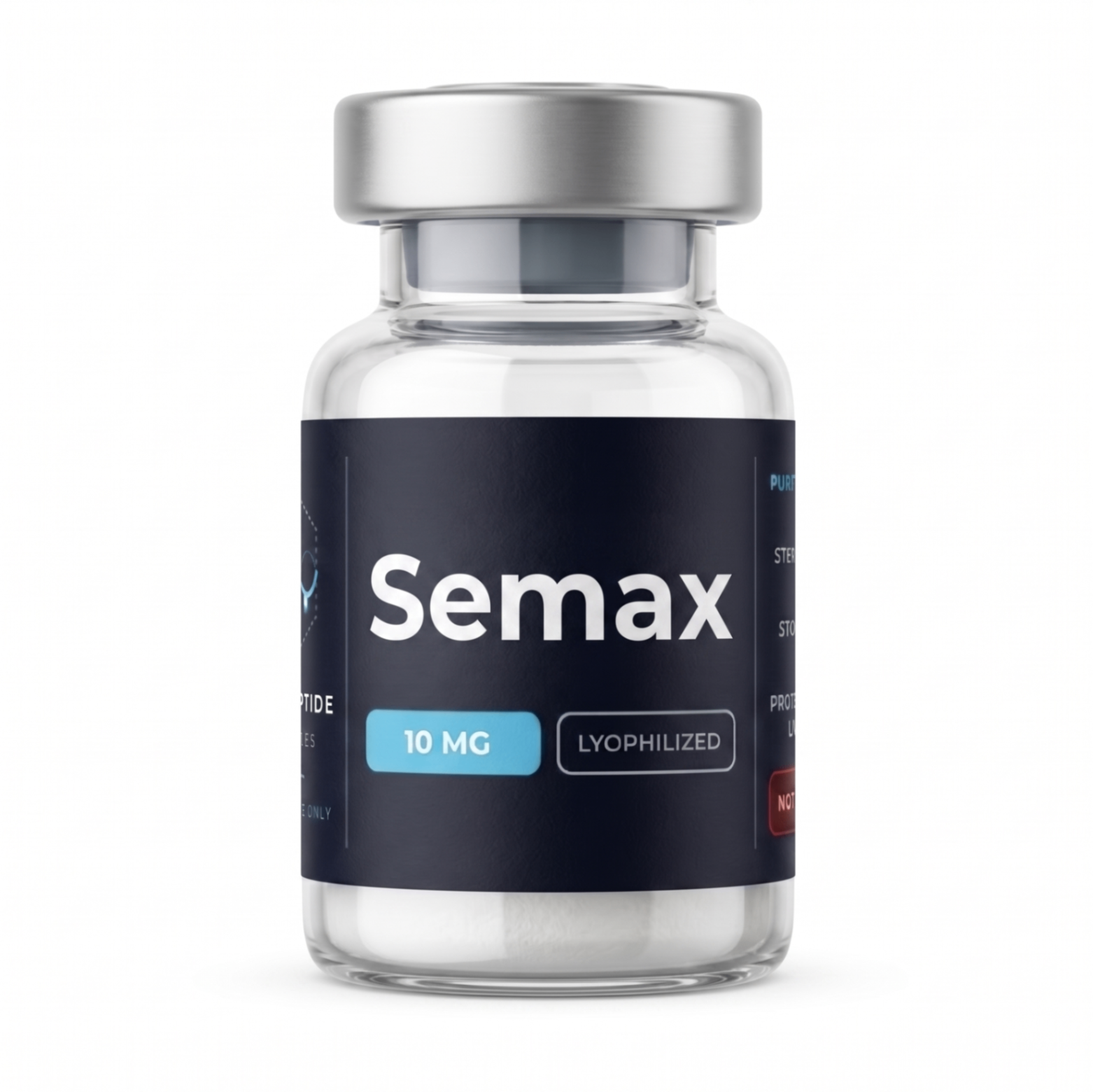
Semax
Russian nootropic heptapeptide. Cognitive endurance and focus.
- Boosts focus, attention, and mental stamina.
- Supports mood and stress resilience.
- Supports nerve cell protection and recovery.
- Keeps you sharp during demanding work.
Synthetic analog of ACTH(4-10). Increases BDNF expression and cerebral acetylcholine, studied for stroke recovery and attention.
Semax (Met-Glu-His-Phe-Pro-Gly-Pro) was developed at the Russian Academy of Sciences. Nasal delivery is standard for CNS effect.
- 10.5–1 mg subcutaneous, once daily.
- 2AM dosing commonly referenced.
- Reconstitution
- 2 mL bacteriostatic water into a 10 mg vial → 5 mg/mL (each 0.1 mL = 500 mcg).
- Typical research dose
- Commonly referenced at 0.5–1 mg per day, subcutaneous.
- Frequency
- Once daily, AM dosing commonly referenced.
- Vial duration
- A 10 mg vial covers ~10 days at 1 mg/day and ~20 days at 0.5 mg/day — both inside the 30-day reconstituted-use window.
- Storage
- Refrigerate 2–8 °C; use within 30 days reconstituted.
- Rotate subcutaneous injection sites to minimize local irritation.
- Morning administration is the most commonly referenced timing.
Understanding Semax
Sharper focus, clearer thinking
Written for people new to peptides. Clear language, careful claims, no dosing instructions.
+What is Semax?
Semax is a short heptapeptide derived from a fragment of ACTH. It was developed in Russia and is in clinical use there for stroke recovery and cognitive-support applications.
It is one of the most-used research peptides in the nootropic and cognitive-performance space.
+How Semax was discovered
Semax was developed in the 1980s at the Institute of Molecular Genetics in Moscow as a synthetic analogue of a fragment of ACTH (4–10). It was approved in Russia in the 1990s and is included on the official list of essential drugs there.
It is one of the most widely prescribed nootropic peptides in Russia, with clinical use spanning stroke recovery, cognitive support in elderly patients, and pediatric attention research.
+How Semax works in the body
- Semax raises levels of BDNF (brain-derived neurotrophic factor) and NGF (nerve growth factor) — the body's main signals for forming and maintaining neural connections.
- It also adjusts dopaminergic and serotonergic systems, which is part of why it is described as both focus-enhancing and mood-stabilizing.
- Animal work shows it can cross the blood-brain barrier via the olfactory route, which is why intranasal formulations exist alongside subcutaneous.
+Benefits
- Boosts focus, attention, and mental stamina.
- Supports mood and stress resilience.
- Supports nerve cell protection and recovery.
- Keeps you sharp during demanding work.
+Research highlights
Semax has a long Russian clinical history, especially in ischemic stroke recovery (where it is part of standard care in some Russian hospitals), cognitive-impairment research, and pediatric attention studies. Western controlled data is more limited.
Main research areas: BDNF/NGF biology, ischemic stroke recovery, ADHD models, and stress-resilience endpoints.
Compared with selank it leans toward activation/focus, where selank leans toward calm — they are often discussed as a 'focus and calm' pair.
+What researchers commonly report
Improved focus, calmer mental state under pressure, and clearer thinking during demanding tasks are the most common reports.
+Why researchers find Semax interesting
Semax is one of very few cognitive peptides with a real clinical history rather than just animal data — and it works by upregulating the body's own neurotrophic factors rather than by direct stimulation, which is mechanistically unusual.
+Quality markers we look for
- HPLC purity reviewed with a target of ≥99%
- Mass spectrometry identity confirmation
- LAL endotoxin screening on applicable batches
- Lyophilized (freeze-dried) format for stability
- Careful storage and handling — keep cold, reconstitute with sterile water
+Often paired with
The data your lab notebook needs.
Pulled from the verification packet included with each shipment. Cross-check the batch ID on your vial against the COA.
- Molecular Weight
- 813.93 g/mol
- Sequence
- Met-Glu-His-Phe-Pro-Gly-Pro (7 AA)
- CAS Number
- 80714-61-0
- Synonyms
- ACTH(4-7)PGP analog
- Purity
- 99%+
- Source
- Synthetic
- Storage
- Lyophilized: 2–8 °C. Reconstituted: 2–8 °C, use within 30 days.
- Reconstitution
- Add 2 mL bacteriostatic water for nasal solution. Each 0.1 mL spray = 550 mcg.
- Half-life
- ~20 minutes (CNS effects longer)