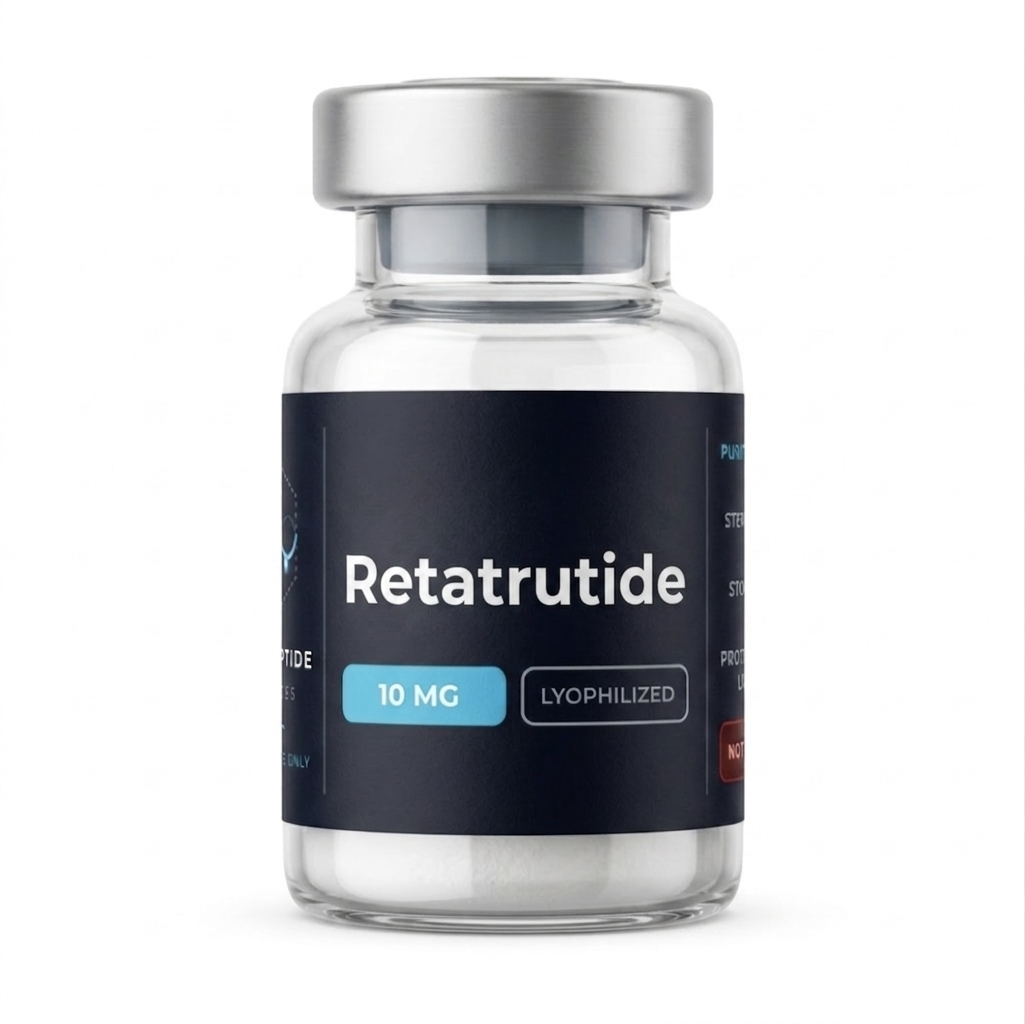
Retatrutide
Triple-agonist GLP-1 / GIP / glucagon. The most aggressive fat-loss peptide in trials.
- Cuts appetite fast — meals feel smaller and more satisfying.
- Delivers the biggest weight and fat-loss results of any peptide we carry.
- Improves blood sugar control and insulin sensitivity.
- Improves liver fat levels.
- Just one injection a week.
Investigational triple-agonist on GLP-1, GIP, and glucagon receptors. Phase II data shows mean weight reduction approaching 24% at 48 weeks at the highest dose.
Retatrutide (LY-3437943) is a unipeptide that simultaneously activates GLP-1, GIP, and glucagon receptors. The glucagon arm drives basal energy expenditure upward — a mechanism the dual-agonists do not have.
- 1Titration: Week 1–4: 2 mg once weekly; Week 5–8: 4 mg once weekly; Week 9–12: 6–8 mg once weekly.
- 2Maintenance: 8–12 mg once weekly, subcutaneous.
- 3Always titrate from the lowest dose to manage GI tolerability; rotate injection sites.
- Reconstitution
- 2 mL bacteriostatic water into a 10 mg vial → 5 mg/mL (each 0.1 mL = 500 mcg).
- Typical research dose
- Research dose-finding ranges of ~2–12 mg per week, titrated upward over several weeks.
- Frequency
- Once weekly, subcutaneous.
- Vial duration
- A 10 mg vial lasts ~5 weeks at 2 mg/week, ~2 weeks at 5 mg/week, and ~1 week at the upper 8–12 mg titration window. At low weekly doses, the 28-day reconstituted-use window is the practical cap — reconstitute in halves if dosing slower than 2.5 mg/week.
- Storage
- Refrigerate 2–8 °C after reconstitution; use within 28 days. Lyophilized vials freezer-stable.
- Always titrate from the lowest dose to manage GI tolerability in research models.
- Rotate injection sites in research animals to minimize local irritation.
Understanding Retatrutide
The strongest fat-loss peptide available
Written for people new to peptides. Clear language, careful claims, no dosing instructions.
+What is Retatrutide?
Retatrutide is a single-molecule peptide that activates three different metabolic receptors at once: GLP-1, GIP and glucagon. Most GLP-1 drugs hit one or two of these. Retatrutide hits all three, which is why it has drawn so much attention in the obesity research community.
It belongs to the newest generation of incretin-mimetic peptides — engineered relatives of natural hormones your gut releases after a meal — and is sometimes described as acting on three receptors at once, to distinguish it from single-target (semaglutide) and two-target (tirzepatide) molecules.
The molecule was designed to be stable in the bloodstream for a full week, so each administration covers seven days of receptor activity from a single subcutaneous injection.
+How Retatrutide was discovered
Retatrutide (development code LY3437943) emerged from Eli Lilly's incretin research program in the early 2020s and became one of the most-anticipated obesity candidates of the decade. It is widely seen as the natural successor to tirzepatide in the same lab.
Researcher interest grew sharply after early Phase 1 and Phase 2 read-outs reported some of the largest body-weight changes ever observed for an investigational metabolic peptide — drawing comparisons across the entire GLP-1 class.
+How Retatrutide works in the body
- GLP-1 activation slows gastric emptying so meals feel filling for longer, dampens appetite signals in the brain's hypothalamus, and improves how the pancreas releases insulin in response to food.
- GIP activation supports insulin sensitivity and is thought to influence how fat tissue stores and releases energy — and may also soften the nausea that pure GLP-1 agonism can cause.
- Glucagon activation is the unique third arm: it nudges the liver and fat tissue toward burning stored energy, which means retatrutide raises total energy expenditure on top of cutting appetite. That combination is what makes it stand out from older GLP-1 molecules.
+Benefits
- Cuts appetite fast — meals feel smaller and more satisfying.
- Delivers the biggest weight and fat-loss results of any peptide we carry.
- Improves blood sugar control and insulin sensitivity.
- Improves liver fat levels.
- Just one injection a week.
+Research highlights
Retatrutide is in late-stage clinical research for obesity and metabolic disease (conditions linked to how the body handles fat and sugar), with active Phase 3 programs — the last stage before a drug can be approved — running under names such as TRIUMPH for obesity and TRIUMPH-MASH for fatty-liver disease.
Published Phase 2 obesity data reported body-weight changes in the 17–24% range over 48 weeks at the higher dose tiers — numbers widely discussed as the largest reported for any incretin-class molecule to date.
Investigators are also studying its effects on hepatic fat (MASLD/MASH), cardiovascular risk markers, and obstructive sleep apnea — areas where appetite suppression alone cannot fully explain the observed improvements.
+What researchers commonly report
Researchers commonly report rapid early appetite suppression, fewer cravings, and meaningful changes in body composition over multi-week protocols. Gastrointestinal adjustment in the first weeks — mild nausea, slower digestion, occasional reflux — is also widely reported and typically settles with titration.
+Why researchers find Retatrutide interesting
Retatrutide is the first incretin molecule to combine all three of the major metabolic-hormone arms in one weekly injection. For researchers tracking the GLP-1 class, it represents the current frontier of what a single peptide can do for energy balance — and is the closest thing the literature has to a 'maximum-effect' incretin reference.
+Quality markers we look for
- HPLC purity reviewed with a target of ≥99%
- Mass spectrometry identity confirmation
- LAL endotoxin screening on applicable batches
- Lyophilized (freeze-dried) format for stability
- Careful storage and handling — keep cold, reconstitute with sterile water
+Often paired with
The data your lab notebook needs.
Pulled from the verification packet included with each shipment. Cross-check the batch ID on your vial against the COA.
- Molecular Weight
- 4731.5 g/mol
- Sequence Length
- 39 amino acids
- CAS Number
- 2381089-83-2
- Synonyms
- LY-3437943
- Purity
- 99%+
- Source
- Synthetic
- Storage
- Lyophilized: 2–8 °C. Reconstituted: 2–8 °C, use within 30 days.
- Reconstitution
- Add 2 mL bacteriostatic water to the 20 mg vial. Each 0.1 mL = 1 mg.
- Half-life
- ~6 days