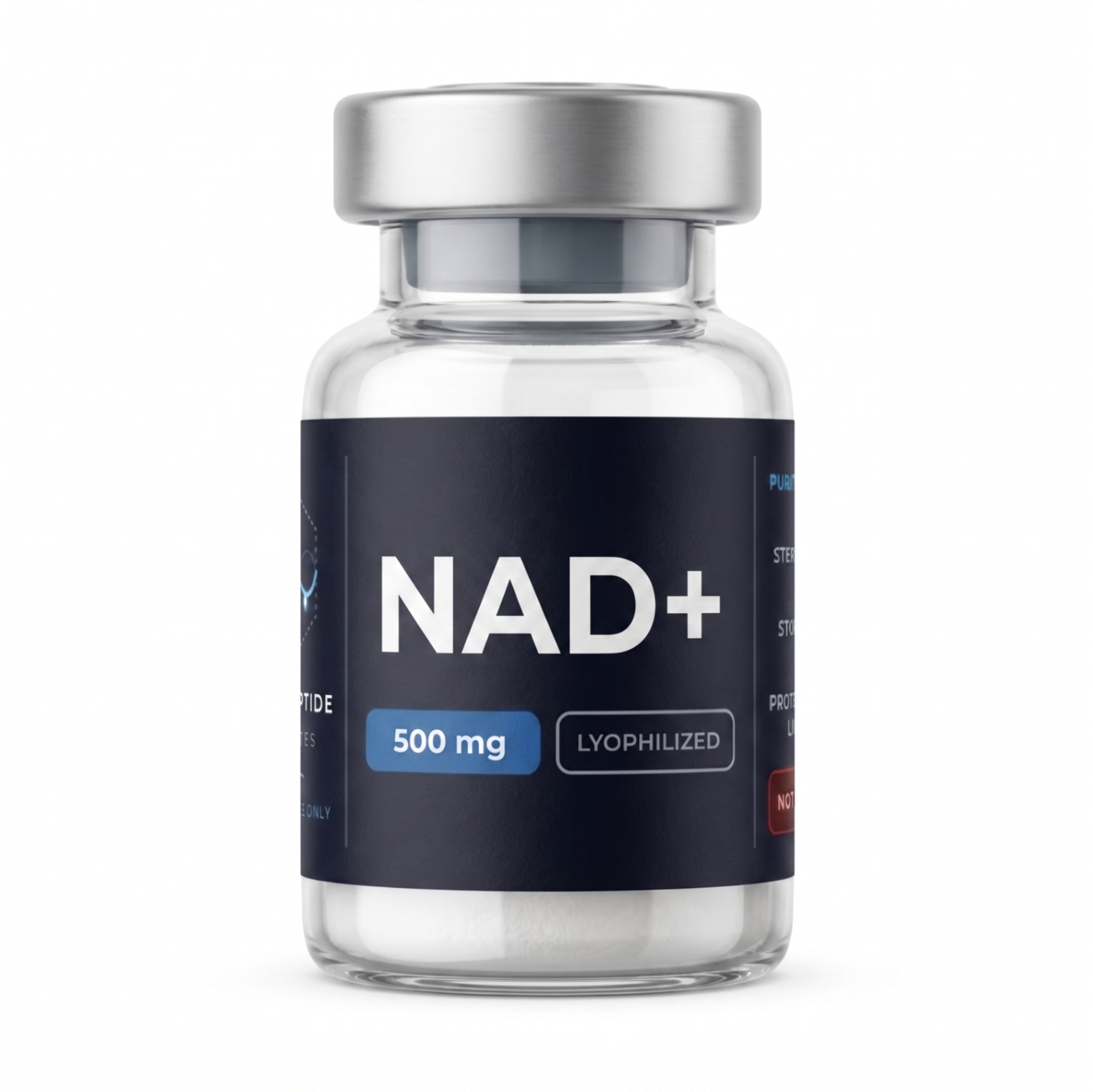
NAD+
Nicotinamide adenine dinucleotide. The redox currency of every cell.
- Boosts cellular energy and mitochondrial function.
- Sharpens mental clarity and focus.
- Supports DNA repair and cellular longevity.
- Cuts feelings of fatigue.
Direct NAD+ injection. Bypasses the salvage pathway and elevates plasma NAD+ within minutes.
NAD+ is the obligate cofactor for sirtuins, PARPs, and the electron-transport chain. Cellular NAD+ falls roughly 50% between age 20 and 60.
- 150 mg subcutaneous, once daily, 5 days per week (2 days off).
- 2Slow push; many protocols dilute each dose with 0.5–1 mL sterile saline to soften the SC sting.
- 3Rotate injection sites to minimize local irritation.
- Reconstitution
- 5 mL bacteriostatic water into a 500 mg vial → 100 mg/mL (each 0.5 mL = 50 mg). Many research protocols dilute the SC dose further with sterile saline to soften injection-site sting.
- Typical research dose
- Commonly referenced at 50 mg per administration, subcutaneous.
- Frequency
- Once daily, 5 days per week (2 days off).
- Vial duration
- A 500 mg vial covers 10 dosing days at 50 mg/day (= 250 mg/week, 5 days on / 2 off) — finishing inside the 14-day reconstituted-use window with no waste.
- Storage
- Refrigerate 2–8 °C; use within 14 days reconstituted. Protect from light.
- Inject slowly — rapid push is widely reported as the main cause of SC sting.
- Many protocols pre-dilute each 0.5 mL dose with 0.5–1 mL of sterile saline to soften the injection.
- Rotate subcutaneous sites to limit local irritation.
Understanding NAD+
Recharge your cells
Written for people new to peptides. Clear language, careful claims, no dosing instructions.
+What is NAD+?
NAD+ is not a peptide — it is a fundamental coenzyme present in every cell in your body. It sits at the center of how cells turn food into usable energy and how they repair their own DNA.
Cellular NAD+ levels decline with age (some tissue measurements show ~50% lower NAD+ by middle age vs. youth), and restoring them is one of the most actively researched topics in longevity biology.
Direct injectable NAD+ is one of three main strategies for raising NAD+ — the others being precursors like NR (nicotinamide riboside) and NMN (nicotinamide mononucleotide), which the body converts to NAD+ internally.
+How NAD+ was discovered
NAD+ was first identified by Arthur Harden and William Young in 1906 as a 'cozymase' essential to fermentation — work that contributed to the 1929 Nobel Prize in Chemistry. Its central role in metabolism was mapped over the next century.
Modern longevity interest in NAD+ began in the 2000s with the discovery of sirtuins — NAD+-dependent enzymes linked to lifespan in model organisms — and exploded after work from Charles Brenner, Shin-ichiro Imai, David Sinclair and others mapped the age-related decline of NAD+ in tissue.
+How NAD+ works in the body
- NAD+ is the substrate that sirtuins (longevity-associated enzymes), PARPs (DNA-repair enzymes) and CD38 use to do their jobs. When NAD+ runs low, all three classes of enzyme work less efficiently.
- It also shuttles electrons through the mitochondrial electron-transport chain — the final step in producing ATP, the body's energy currency. Most of the ATP your cells make depends on a constant NAD+/NADH cycle.
- Raising NAD+ availability supports mitochondrial output, DNA-repair capacity, and the activity of sirtuin-driven longevity pathways. This is why researchers describe it as 'restoring cellular bandwidth' rather than 'adding a new function'.
+Benefits
- Boosts cellular energy and mitochondrial function.
- Sharpens mental clarity and focus.
- Supports DNA repair and cellular longevity.
- Cuts feelings of fatigue.
+Research highlights
NAD+ biology is one of the most actively published areas in healthy-aging research, with ongoing trials in metabolic disease, neurodegenerative conditions, exercise physiology, and post-viral fatigue.
Main research areas: mitochondrial function, sirtuin/PARP biology, DNA-damage repair, neuroprotection, and skeletal-muscle energetics.
Compared with NMN/NR precursors, direct injectable NAD+ raises tissue levels faster but the routes carry different pharmacokinetic profiles — investigators choose based on the question.
+What researchers commonly report
Energy, clarity and improved exercise tolerance are common reports. Flushing or warmth during faster administration is also frequently noted — usually solved by slow push or pre-dilution with saline.
+Why researchers find NAD+ interesting
NAD+ is interesting because it sits at the intersection of three of the biggest pieces of modern aging biology — mitochondrial energy, DNA repair, and sirtuin signaling. Few molecules can claim that kind of central position in cellular metabolism.
+Quality markers we look for
- HPLC purity reviewed with a target of ≥99%
- Mass spectrometry identity confirmation
- LAL endotoxin screening on applicable batches
- Lyophilized (freeze-dried) format for stability
- Careful storage and handling — keep cold, reconstitute with sterile water
+Often paired with
The data your lab notebook needs.
Pulled from the verification packet included with each shipment. Cross-check the batch ID on your vial against the COA.
- Molecular Weight
- 663.43 g/mol
- Type
- Dinucleotide (non-peptide)
- CAS Number
- 53-84-9
- Synonyms
- Nicotinamide adenine dinucleotide
- Purity
- 99%+
- Source
- Synthetic
- Storage
- Lyophilized: 2–8 °C, protect from light. Reconstituted: 2–8 °C, use within 14 days.
- Reconstitution
- Add 5 mL bacteriostatic water to the 500 mg vial. Each 1 mL = 100 mg.
- Half-life
- Plasma minutes; tissue 24–72 hours