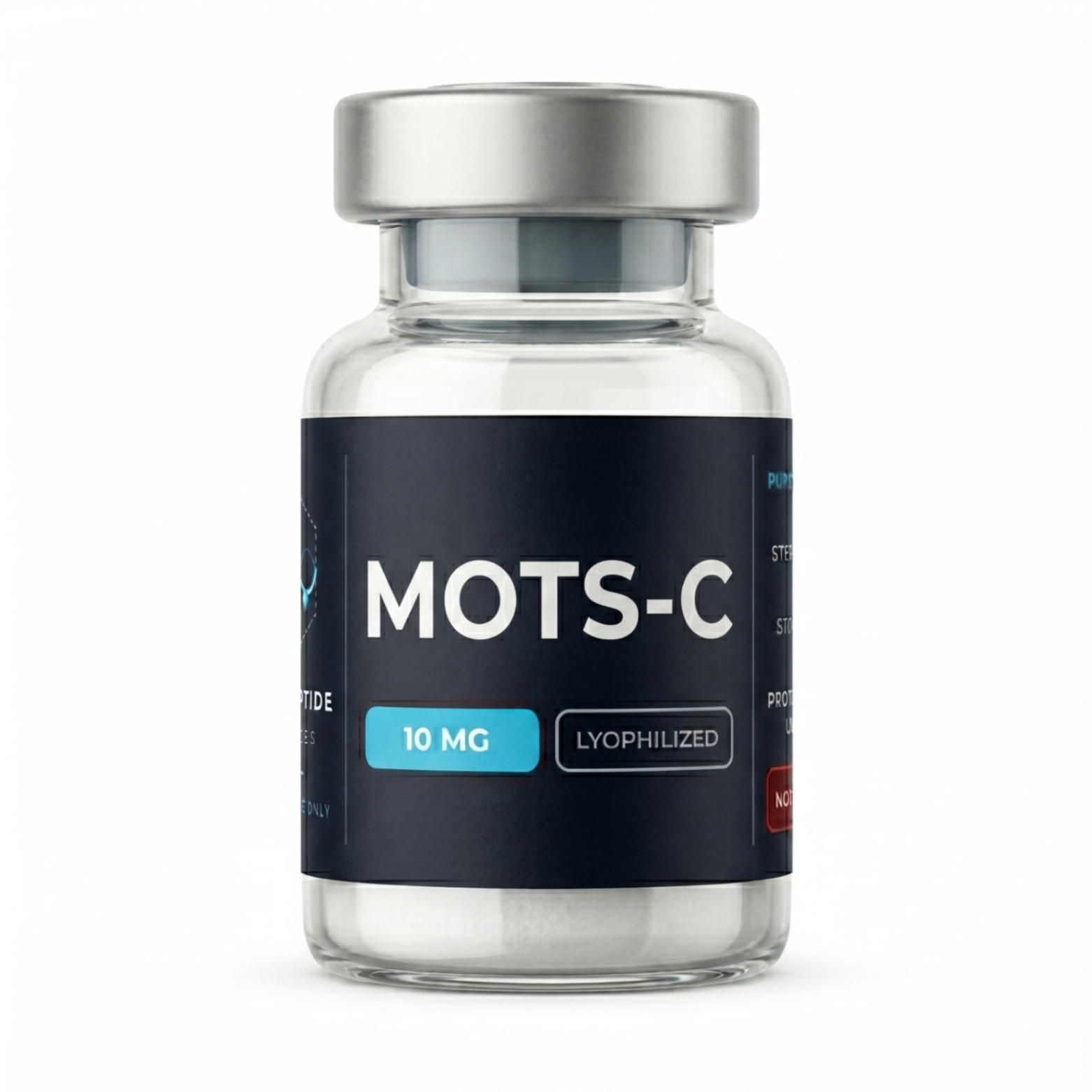
MOTS-c
Mitochondrial-derived peptide. Metabolic flexibility and exercise mimetic.
- Improves insulin sensitivity and fat burning.
- Mimics the metabolic effects of exercise.
- Boosts mitochondrial energy output.
- Supports endurance and energy levels.
16-amino-acid peptide encoded in mitochondrial DNA. Activates AMPK and improves insulin sensitivity.
MOTS-c is encoded directly in mitochondrial DNA and signals from mitochondria to the nucleus via AMPK. Plasma MOTS-c falls with age and is partially restored by exercise.
- 15–10 mg subcutaneous, 2–3× per week.
- 2Cycle: 12 weeks on, 8 weeks off.
- Reconstitution
- 2 mL bacteriostatic water into a 10 mg vial → 5 mg/mL (each 0.1 mL = 500 mcg).
- Typical research dose
- Reference 5–10 mg per week, often split into 2–3 administrations.
- Frequency
- 2–3× weekly, subcutaneous.
- Vial duration
- A 10 mg vial covers ~1 week at the 10 mg/week upper end and ~2 weeks at 5 mg/week — both inside the 30-day reconstituted-use window.
- Storage
- Refrigerate 2–8 °C; use within 30 days reconstituted.
Understanding MOTS-c
Exercise in a vial, made by your own mitochondria
Written for people new to peptides. Clear language, careful claims, no dosing instructions.
+What is MOTS-c?
MOTS-c is a short peptide encoded inside your mitochondrial DNA — not your nuclear DNA. That makes it one of a very small class of 'mitokines' that act as messengers between mitochondria and the rest of the body.
It has become one of the most-discussed longevity and metabolic peptides in recent years, partly because the discovery of its existence reframed what mitochondria are capable of producing.
+How MOTS-c was discovered
MOTS-c was discovered in 2015 by Pinchas Cohen's group at USC and was one of the first identified members of a new class called 'mitochondrial-derived peptides' (MDPs) — peptides encoded inside mitochondrial DNA itself.
Its discovery was a major surprise: mitochondrial DNA was thought to encode only the 13 known proteins of the electron-transport chain. Finding a secreted signaling peptide there opened a new research field within months.
+How MOTS-c works in the body
- MOTS-c activates AMPK — the master energy sensor that responds to exercise and fasting — and influences how cells handle glucose and fat.
- It supports insulin sensitivity in muscle, adjusts the cellular stress response, and improves mitochondrial function in research models.
- It can move to the nucleus during metabolic stress and influence which nuclear genes are active — a mitochondria-to-nucleus signaling pattern that is rare among signaling peptides.
+Benefits
- Improves insulin sensitivity and fat burning.
- Mimics the metabolic effects of exercise.
- Boosts mitochondrial energy output.
- Supports endurance and energy levels.
+Research highlights
MOTS-c is actively studied in metabolic and aging research, including obesity, diabetes, age-related muscle decline (sarcopenia), and exercise physiology.
Main research areas: AMPK signaling, insulin sensitivity, mitochondrial biogenesis, and the broader 'mitokine' family that MOTS-c helped open.
Compared with SS-31 it works upstream (signaling) rather than at the mitochondrial membrane — investigators sometimes pair the two for layered coverage.
+What researchers commonly report
Improvements in training endurance, recovery from cardio, and steady metabolic changes over a protocol are commonly reported.
+Why researchers find MOTS-c interesting
MOTS-c is interesting because its very existence rewrote what mitochondrial DNA was thought to do. It is the flagship of a new peptide class that researchers are still mapping out almost a decade after the original discovery.
+Quality markers we look for
- HPLC purity reviewed with a target of ≥99%
- Mass spectrometry identity confirmation
- LAL endotoxin screening on applicable batches
- Lyophilized (freeze-dried) format for stability
- Careful storage and handling — keep cold, reconstitute with sterile water
+Often paired with
The data your lab notebook needs.
Pulled from the verification packet included with each shipment. Cross-check the batch ID on your vial against the COA.
- Molecular Weight
- 2174.59 g/mol
- Sequence Length
- 16 amino acids
- CAS Number
- 1627580-64-6
- Synonyms
- Mitochondrial ORF of the 12S rRNA-c
- Purity
- 99%+
- Source
- Mitochondrial-derived, synthetic
- Storage
- Lyophilized: 2–8 °C. Reconstituted: 2–8 °C, use within 30 days.
- Reconstitution
- Add 2 mL bacteriostatic water to the 10 mg vial. Each 1 mL = 5 mg.
- Half-life
- ~3 hours