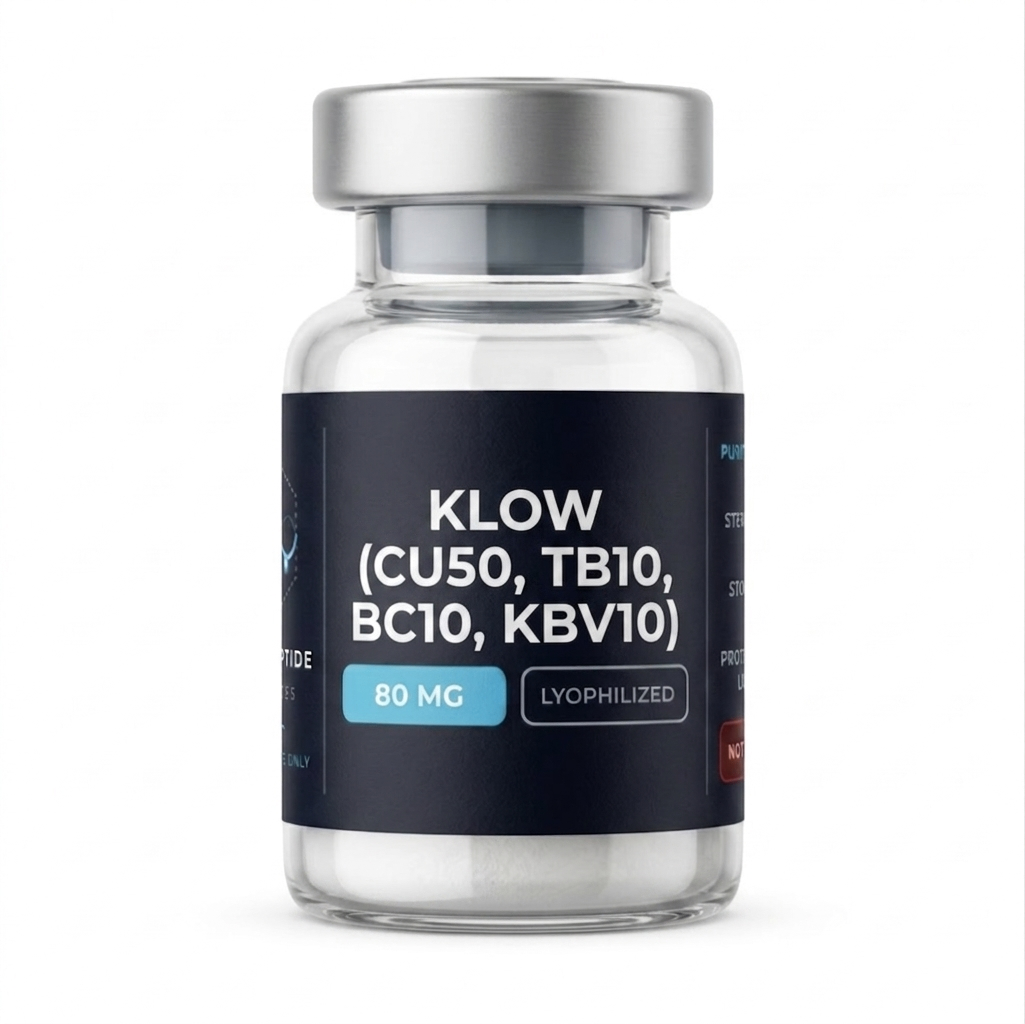
KLOW
Four-peptide systemic repair blend. GHK-Cu, TB-500, BPC-157, KPV.
- Combines deep-tissue recovery with visible skin benefits.
- Improves skin tone and quality.
- One vial, several mechanisms — simple and convenient.
Pre-blended recovery cocktail: GHK-Cu 50 mg, TB-500 10 mg, BPC-157 10 mg, KPV 10 mg in a single vial. Combines angiogenic, anti-inflammatory, and tissue-remodeling pathways.
KLOW stacks four of the most studied repair peptides into one vial. GHK-Cu drives copper-dependent gene expression for connective tissue. TB-500 mobilizes stem cells. BPC-157 promotes microvascular formation. KPV calms mucosal and systemic inflammation. The combined activity is broader than any single peptide.
- 1Loading: 0.3 mL subcutaneous near the area of interest, daily for 2 weeks.
- 2Maintenance: 0.2 mL 3× weekly for 4–6 weeks. Rotate injection sites.
- Reconstitution
- 2 mL bacteriostatic water into the blended vial → standard 5 mg/mL working stock (refer to component label).
- Typical research dose
- Reference 0.1–0.2 mL per administration of the reconstituted blend.
- Frequency
- Once daily, subcutaneous.
- Vial duration
- A blended vial typically lasts ~20–30 days at 0.1 mL/day and ~10–15 days at 0.2 mL/day — kept inside the 30-day reconstituted-use window.
- Storage
- Refrigerate 2–8 °C; use within 30 days reconstituted.
- Blend stack (KPV / Larazotide / BPC-157 / GHK-Cu family) — defer to the printed lot label for exact mass breakdown.
Understanding KLOW
One vial, full recovery plus glow
Written for people new to peptides. Clear language, careful claims, no dosing instructions.
+What is KLOW?
KLOW is a research blend that combines several recovery-oriented peptides into a single vial. The classic formulation includes a GHK-Cu component along with BPC-157 and TB-500-class fragments and Matrixyl/Argireline-style cosmetic peptides.
It is designed for researchers who want layered tissue, skin and recovery effects in one preparation.
+How KLOW was discovered
KLOW emerged in research-community compounding circles in the late 2010s as a 'one-vial recovery stack' — a way to run several complementary peptides without juggling four separate vials. It is named after its component initials.
It is a community-developed format rather than a single trademarked product, so the exact blend varies by lab — the lot label is the reliable source for component mass.
+How KLOW works in the body
- GHK-Cu supports copper-dependent collagen and elastin synthesis and adjusts which wound-healing genes are switched on.
- The BPC-157 and TB-500 components contribute angiogenic and tissue-migration effects discussed above.
- Cosmetic-peptide fragments contribute to surface skin signaling — fine lines, tone and turnover are commonly discussed endpoints.
+Benefits
- Combines deep-tissue recovery with visible skin benefits.
- Improves skin tone and quality.
- One vial, several mechanisms — simple and convenient.
+Research highlights
Each component has its own research base. The blend itself is a community-favored format rather than a formally-studied product, so investigators reference the individual-component literature when designing protocols.
+What researchers commonly report
Researchers often describe combined recovery and skin-quality changes over multi-week protocols.
+Why researchers find KLOW interesting
KLOW is interesting as a convenience preparation: it lets a researcher run a four-peptide protocol from one vial, which is a meaningful workflow simplification when comparing recovery endpoints across multiple subjects.
+Quality markers we look for
- HPLC purity reviewed with a target of ≥99%
- Mass spectrometry identity confirmation
- LAL endotoxin screening on applicable batches
- Lyophilized (freeze-dried) format for stability
- Careful storage and handling — keep cold, reconstitute with sterile water
+Often paired with
The data your lab notebook needs.
Pulled from the verification packet included with each shipment. Cross-check the batch ID on your vial against the COA.
- Composition
- GHK-Cu 50 mg · TB-500 10 mg · BPC-157 10 mg · KPV 10 mg
- Total Mass
- 80 mg per vial
- Purity
- 99%+ HPLC per component
- Application
- Systemic recovery research
- Purity
- Not yet published
- Source
- Not yet published
- Storage
- Lyophilized: 2–8 °C. Reconstituted: 2–8 °C, use within 21 days.
- Reconstitution
- Add 3 mL bacteriostatic water to the blend vial.
- Half-life
- Mixed: hours to days depending on component