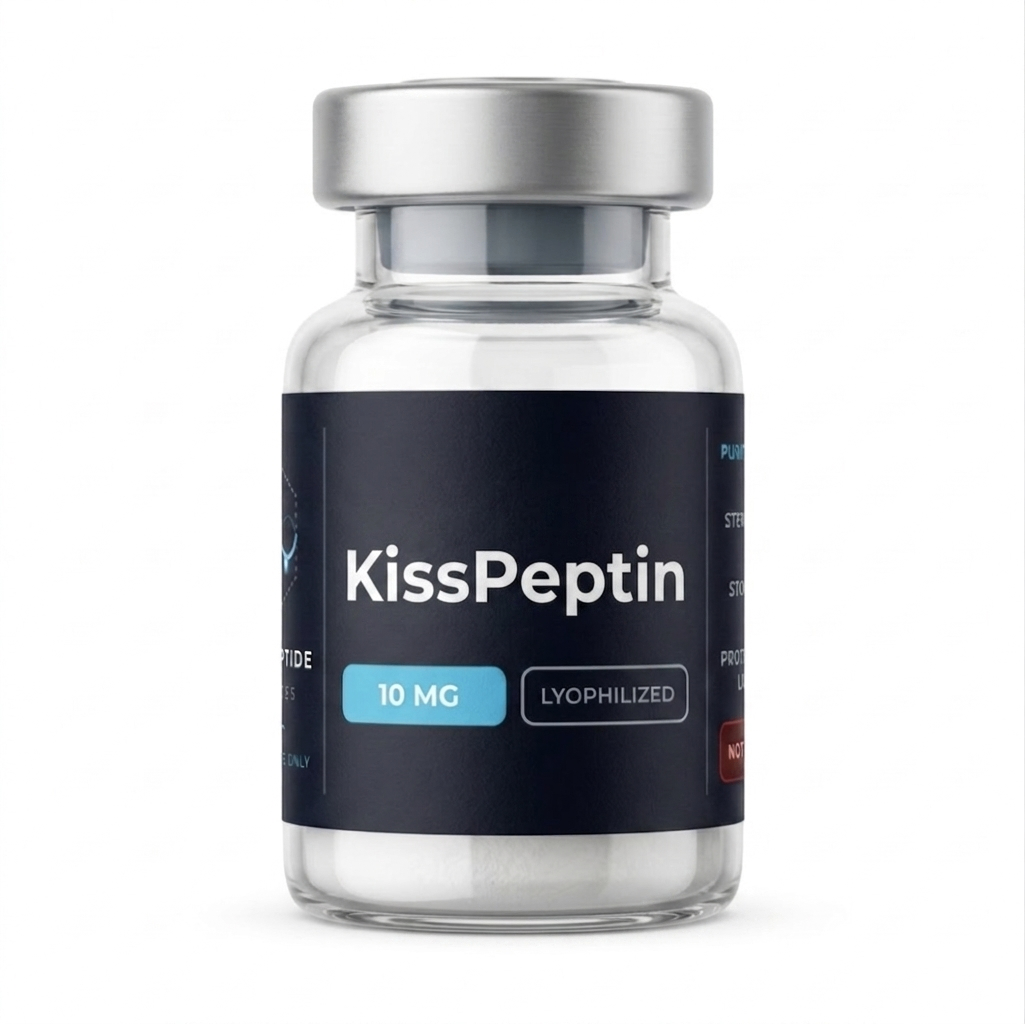
Kisspeptin-10
Decapeptide upstream of GnRH. Endogenous HPG-axis research.
- Triggers the hormone signals that drive your body's own testosterone or estrogen production.
- Supports fertility, libido, and reproductive hormone balance.
- Helps the hormone system recover after suppression, such as after steroid or TRT use.
C-terminal active fragment of kisspeptin. Triggers GnRH release and downstream LH/FSH; studied for fertility and hypogonadism.
Kisspeptin-10 acts at the KISS1R (GPR54) receptor on GnRH neurons. The most upstream physiological switch of the reproductive axis.
- 1100–200 mcg subcutaneous, every other day.
- 2Cycle: 4–8 weeks.
- Reconstitution
- 2 mL bacteriostatic water into a 10 mg vial → 5 mg/mL (each 0.04 mL = 200 mcg).
- Typical research dose
- Research reference 100–300 mcg per administration.
- Frequency
- Once daily or per protocol, subcutaneous.
- Vial duration
- A 10 mg vial covers ~33 days at 300 mcg/day. At 100 mcg/day the raw math reaches ~100 days, exceeding the 30-day reconstituted window — reconstitute the vial in halves (5 mg each) for slower protocols.
- Storage
- Refrigerate 2–8 °C; use within 30 days reconstituted.
Understanding Kisspeptin-10
Switches on your body's own sex hormone production
Written for people new to peptides. Clear language, careful claims, no dosing instructions.
+What is Kisspeptin-10?
Kisspeptin-10 is the active 10-amino-acid fragment of kisspeptin, the master regulator of GnRH release and therefore the entire HPG (hypothalamic-pituitary-gonadal) signaling chain.
It sits one step upstream of LH, FSH, and the downstream sex hormones in both men and women — making it conceptually different from any other peptide that influences libido or reproduction.
+How Kisspeptin-10 was discovered
Kisspeptin was first identified in 1996 as a tumor-metastasis suppressor (originally named metastin) at Pennsylvania State University. Its central role in puberty and reproductive biology was discovered in 2003 when mutations in its receptor (KISS1R/GPR54) were linked to absent puberty.
That discovery rewrote reproductive endocrinology — kisspeptin is now recognized as the upstream switch that turns on the entire HPG signaling chain, and research interest has expanded rapidly ever since.
+How Kisspeptin-10 works in the body
- Kisspeptin-10 binds the KISS1R receptor in the hypothalamus and triggers GnRH release.
- GnRH in turn drives LH and FSH from the pituitary, which then act on the gonads to produce testosterone or estradiol.
- The peptide is being investigated as a more physiologic alternative to GnRH analogues for fertility and hormonal-signaling research — because it works one step upstream, it preserves more of the natural pulsatile rhythm.
+Benefits
- Triggers the hormone signals that drive your body's own testosterone or estrogen production.
- Supports fertility, libido, and reproductive hormone balance.
- Helps the hormone system recover after suppression, such as after steroid or TRT use.
+Research highlights
Kisspeptin biology is one of the most actively researched areas in reproductive endocrinology, including fertility (ovulation triggering), hypothalamic amenorrhea, hypogonadism, and metabolic-reproductive crosstalk.
Main research areas: ovulation induction, male hypogonadism, post-cycle HPG-signaling recovery, and metabolic regulation of reproduction.
Compared with PT-141 it works on the hormonal signaling chain rather than central arousal — different question, different tool.
+What researchers commonly report
Researchers commonly report subtle shifts in baseline libido, energy and mood across a protocol.
+Why researchers find Kisspeptin-10 interesting
Kisspeptin-10 is interesting because it sits at the very top of the reproductive cascade — the master switch above GnRH itself. That kind of upstream position is rare for an injectable research peptide.
+Quality markers we look for
- HPLC purity reviewed with a target of ≥99%
- Mass spectrometry identity confirmation
- LAL endotoxin screening on applicable batches
- Lyophilized (freeze-dried) format for stability
- Careful storage and handling — keep cold, reconstitute with sterile water
+Often paired with
The data your lab notebook needs.
Pulled from the verification packet included with each shipment. Cross-check the batch ID on your vial against the COA.
- Molecular Weight
- 1302.5 g/mol
- Sequence Length
- 10 amino acids
- CAS Number
- 374675-21-5
- Synonyms
- Metastin 45-54, KP-10
- Purity
- 99%+
- Source
- Synthetic
- Storage
- Lyophilized: 2–8 °C. Reconstituted: 2–8 °C, use within 30 days.
- Reconstitution
- Add 2 mL bacteriostatic water to the 10 mg vial. Each 0.02 mL = 100 mcg.
- Half-life
- ~4 minutes plasma