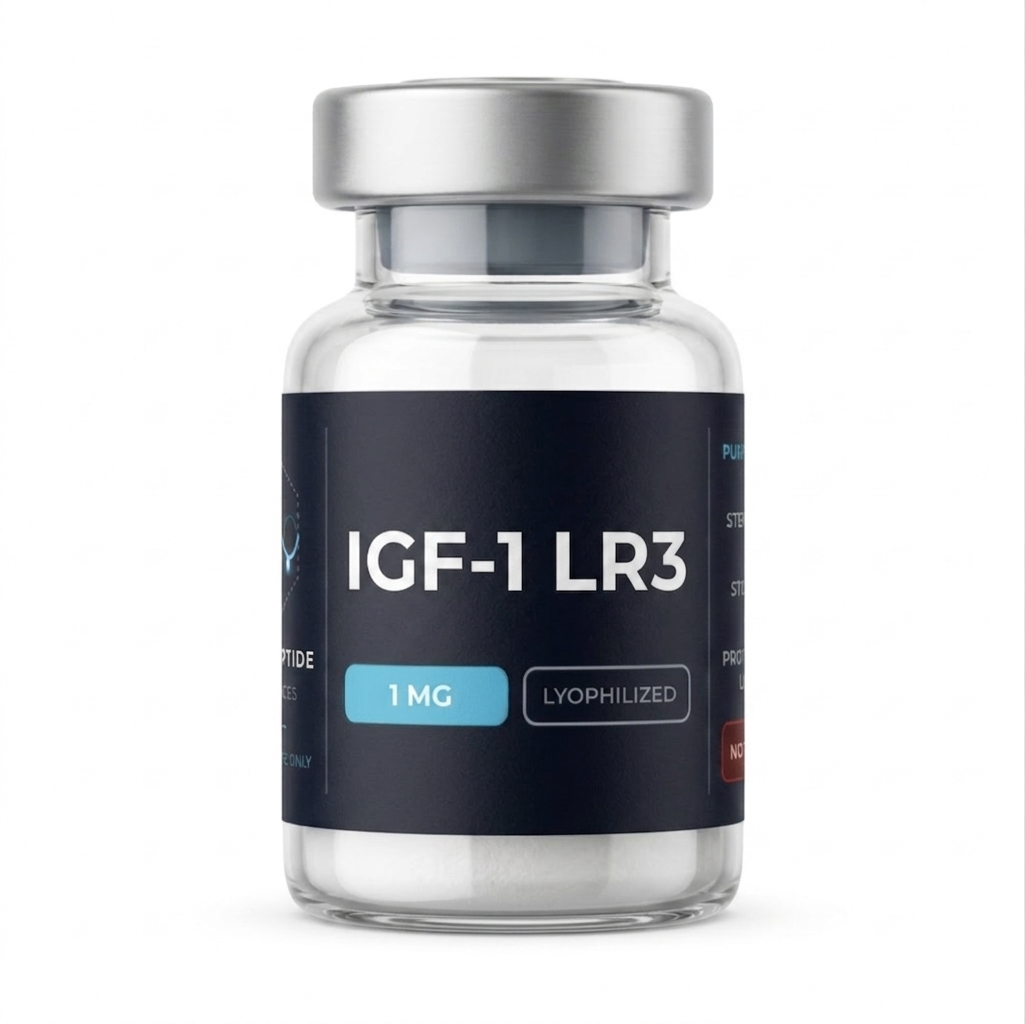
IGF-1 LR3
Long-arginine IGF-1. The direct anabolic downstream of GH.
- Drives muscle growth — bigger fibers and more of them.
- Speeds recovery from heavy training and injury.
- Directs nutrients toward muscle instead of fat.
- Stays active far longer than your body's own IGF-1.
Receptor-grade IGF-1 analog with an N-terminal extension that resists binding-protein sequestration, increasing systemic half-life and tissue exposure.
IGF-1 LR3 (Long R3 IGF-1) is the active mediator of growth-hormone signaling, modified for stability. It binds the IGF-1 receptor with high affinity to drive hypertrophy and tissue repair.
- 120–50 mcg subcutaneous, once daily, timed post-training in research stacks.
- 24–6 days per week. Cycle: 4–6 weeks on, 4 weeks off.
- Reconstitution
- 1 mL bacteriostatic water into a 1 mg vial → 1 mg/mL (each 0.02 mL = 20 mcg).
- Typical research dose
- Reference 20–50 mcg per administration.
- Frequency
- Once daily, subcutaneous — frequently timed post-training in research stacks.
- Vial duration
- A 1 mg vial covers ~20 days at 50 mcg/day. At 20 mcg/day the raw math reaches ~50 days, exceeding the 30-day reconstituted window — reconstitute the vial in halves (0.5 mg each) for slower protocols.
- Storage
- Refrigerate 2–8 °C; use within 30 days reconstituted.
Understanding IGF-1 LR3
Long-acting IGF-1 for serious muscle growth
Written for people new to peptides. Clear language, careful claims, no dosing instructions.
+What is IGF-1 LR3?
IGF-1 LR3 is a modified version of natural IGF-1 with two engineered changes: a 13-amino-acid N-terminal extension and an arginine substitution at position 3. Together these give it a much longer half-life (~20–30 hours vs. ~10 minutes for native IGF-1) and reduced binding to the IGF-binding proteins that normally regulate the hormone in the bloodstream.
That means more of the molecule stays available and active in tissue, which is why it is so widely discussed in muscle and recovery research.
+How IGF-1 LR3 was discovered
IGF-1 LR3 was engineered at GroPep in Australia in the late 1980s as a research-grade IGF-1 analogue with extended half-life and less binding to the proteins that normally carry it in blood. It became the dominant research IGF-1 reagent for cell-culture and animal work and has been cited in thousands of papers.
Its long-acting profile is also why it migrated out of pure lab use and into performance-research stacks, where it sits as the most-discussed IGF-1 analogue in the muscle-biology literature.
+How IGF-1 LR3 works in the body
- IGF-1 binds the IGF-1 receptor on muscle and many other cell types, activating the PI3K/Akt/mTOR pathway that drives protein synthesis and cell growth.
- It also influences glucose uptake into muscle via insulin-receptor cross-talk, which is part of why protocols must be approached carefully — pronounced hypoglycemia is a real consideration.
- Because LR3 evades the IGF-binding proteins that normally buffer native IGF-1, even small doses produce a measurably bigger tissue effect than the same dose of unmodified IGF-1.
+Benefits
- Drives muscle growth — bigger fibers and more of them.
- Speeds recovery from heavy training and injury.
- Directs nutrients toward muscle instead of fat.
- Stays active far longer than your body's own IGF-1.
+Research highlights
IGF-1 LR3 is one of the most-studied IGF-1 analogues in muscle biology, with extensive cell-culture and rodent literature on satellite-cell activation, muscle growth, and tendon repair.
It is also a sensitive molecule: investigators handling it pay close attention to handling, storage, and protocol design.
Compared with HGH it works downstream in the GH signaling chain, which is why it is sometimes used as a more 'direct' research tool for muscle protein-synthesis endpoints.
+What researchers commonly report
Pumps, fullness, and accelerated training adaptation are commonly reported. Sensitivity to hypoglycemia is also a frequently noted consideration, especially when administered on an empty stomach.
+Why researchers find IGF-1 LR3 interesting
IGF-1 LR3 is the molecule that lets researchers study IGF-1's tissue effects without the binding-protein layer that normally controls native IGF-1. That makes it the closest thing the catalog has to a 'pure' anabolic-pathway probe.
+Quality markers we look for
- HPLC purity reviewed with a target of ≥99%
- Mass spectrometry identity confirmation
- LAL endotoxin screening on applicable batches
- Lyophilized (freeze-dried) format for stability
- Careful storage and handling — keep cold, reconstitute with sterile water
+Often paired with
The data your lab notebook needs.
Pulled from the verification packet included with each shipment. Cross-check the batch ID on your vial against the COA.
- Molecular Weight
- 9111.27 g/mol
- Sequence Length
- 83 amino acids
- CAS Number
- 946870-92-4
- Synonyms
- Long R3 IGF-1
- Purity
- 99%+
- Source
- Recombinant
- Storage
- Lyophilized: 2–8 °C. Reconstituted: 2–8 °C, use within 14 days.
- Reconstitution
- Add 1 mL bacteriostatic water to the 1 mg vial. Each 0.02 mL = 20 mcg.
- Half-life
- ~20–30 hours