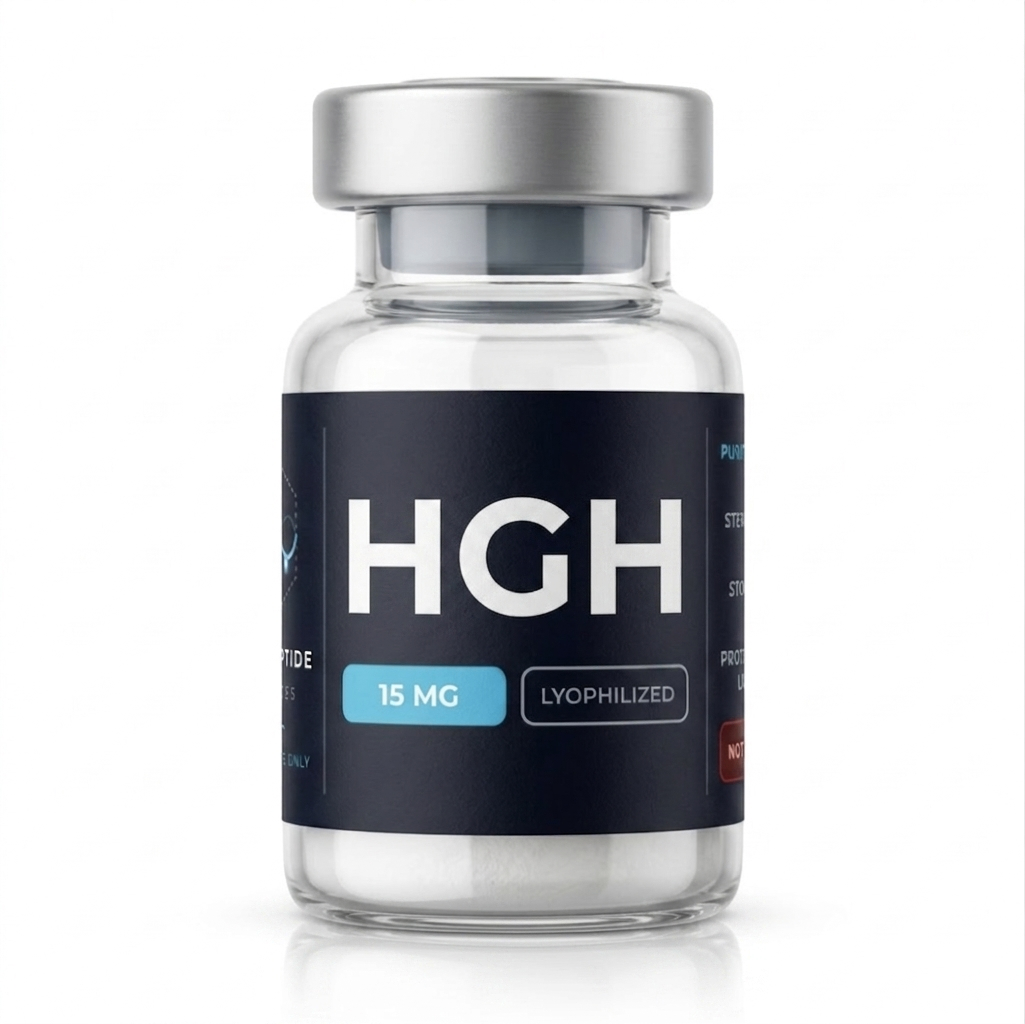
HGH
Recombinant human growth hormone. 191-amino-acid somatropin.
- Raises IGF-1 and everything growth hormone drives in the body.
- Builds lean muscle while helping burn fat.
- Improves skin, hair, and connective tissue.
- Boosts recovery, sleep, and energy.
Recombinant 191-amino-acid somatropin, bio-identical to pituitary-secreted GH. Drives IGF-1 elevation, lipolysis, and connective-tissue support.
Human Growth Hormone (somatropin) is the recombinant version of native pituitary GH. It binds the GHR to upregulate IGF-1 production in the liver and acts directly on adipocytes and connective tissue. Dosing in IU; 15 mg ≈ 45 IU.
- 11–4 IU subcutaneous, once daily AM fasted (or split AM / pre-sleep).
- 2Cycle: 12–16 weeks on, 4 weeks off. Rotate injection sites.
- Reconstitution
- 1.5 mL bacteriostatic water into a 15 mg (~45 IU) vial → 10 mg/mL (each 0.1 mL ≈ 3 IU / 1 mg).
- Typical research dose
- Research reference 1–4 IU per day (≈0.33–1.3 mg).
- Frequency
- Once daily AM, or split AM / PM, subcutaneous.
- Vial duration
- A 15 mg vial covers ~11 days at 4 IU/day and ~28 days at the lower 1.5 IU/day end — fitting the 28-day reconstituted-use window. At 1 IU/day the raw math exceeds 28 days; reconstitute the vial in halves (7.5 mg each).
- Storage
- Refrigerate 2–8 °C after reconstitution; use within 28 days.
Understanding HGH
The real thing — full human growth hormone
Written for people new to peptides. Clear language, careful claims, no dosing instructions.
+What is HGH?
HGH is the full, 191-amino-acid human growth hormone molecule produced recombinantly in bacteria or mammalian cells. It is identical in sequence to the GH that your pituitary makes naturally.
Where GHRH and GHRP peptides ask your body to release more of its own GH, HGH is the hormone itself — which gives a much stronger and more direct effect on GH/IGF-1 signaling. It produces a flat level from outside the body rather than a pulse, which is the main tradeoff vs. GHRH-class peptides.
+How HGH was discovered
Recombinant HGH (somatropin) was first produced by Genentech in 1981 and approved by the FDA in 1985 — one of the earliest recombinant-DNA biologics in clinical use. It replaced the cadaver-derived GH that had been used since the 1950s and immediately became the standard tool for GH research.
Decades of clinical use across pediatric GH deficiency, adult GH deficiency, and HIV-related wasting make it the most-studied GH-related molecule in human pharmacology.
+How HGH works in the body
- HGH binds the GH receptor on the liver to drive IGF-1 production, and binds GH receptors directly on muscle, fat, bone and connective tissue.
- The downstream pathways include increased protein synthesis, fat breakdown in fat tissue, and support for collagen and connective-tissue turnover.
- Because it floods the receptor with a non-pulsatile signal, the body's own GH feedback loops are suppressed during administration — a key reason researchers distinguish it from GHRH/GHRP stacks.
+Benefits
- Raises IGF-1 and everything growth hormone drives in the body.
- Builds lean muscle while helping burn fat.
- Improves skin, hair, and connective tissue.
- Boosts recovery, sleep, and energy.
+Research highlights
HGH has a deep clinical evidence base across pediatric GH deficiency, adult GH-deficiency syndromes, Turner syndrome, idiopathic short stature, and HIV-related wasting.
Active research areas include healthy-aging body composition, recovery from severe burns, and longevity biology (notably the controversial relationship between IGF-1 and lifespan in animal models).
Compared with sermorelin or CJC-1295/Ipamorelin it produces a stronger and more sustained GH/IGF-1 elevation but loses the natural pulse pattern — investigators choose based on which profile matches the question.
+What researchers commonly report
Faster recovery, joint comfort, improved sleep, and gradual body-composition changes over months are commonly reported. Water retention, mild joint stiffness, and insulin-sensitivity adjustments in the first weeks are also typical and usually settle with dose calibration.
+Why researchers find HGH interesting
HGH is the molecule every other GH-related peptide is measured against. It is also the only one that produces a fully replacement-level GH signal — which is why it remains the reference tool for the highest-stakes GH research.
+Quality markers we look for
- HPLC purity reviewed with a target of ≥99%
- Mass spectrometry identity confirmation
- LAL endotoxin screening on applicable batches
- Lyophilized (freeze-dried) format for stability
- Careful storage and handling — keep cold, reconstitute with sterile water
+Often paired with
The data your lab notebook needs.
Pulled from the verification packet included with each shipment. Cross-check the batch ID on your vial against the COA.
- Molecular Weight
- 22125 g/mol (22.1 kDa)
- Sequence Length
- 191 amino acids
- CAS Number
- 12629-01-5
- Conversion
- 15 mg ≈ 45 IU
- Purity
- 99%+
- Source
- Recombinant (E. coli / yeast expression)
- Storage
- Lyophilized: 2–8 °C. Reconstituted: 2–8 °C, use within 21 days.
- Reconstitution
- Add 1.5 mL bacteriostatic water to the 15 mg (45 IU) vial. Each 0.05 mL = 1.5 IU.
- Half-life
- ~2–3 hours plasma; IGF-1 effects 24h+