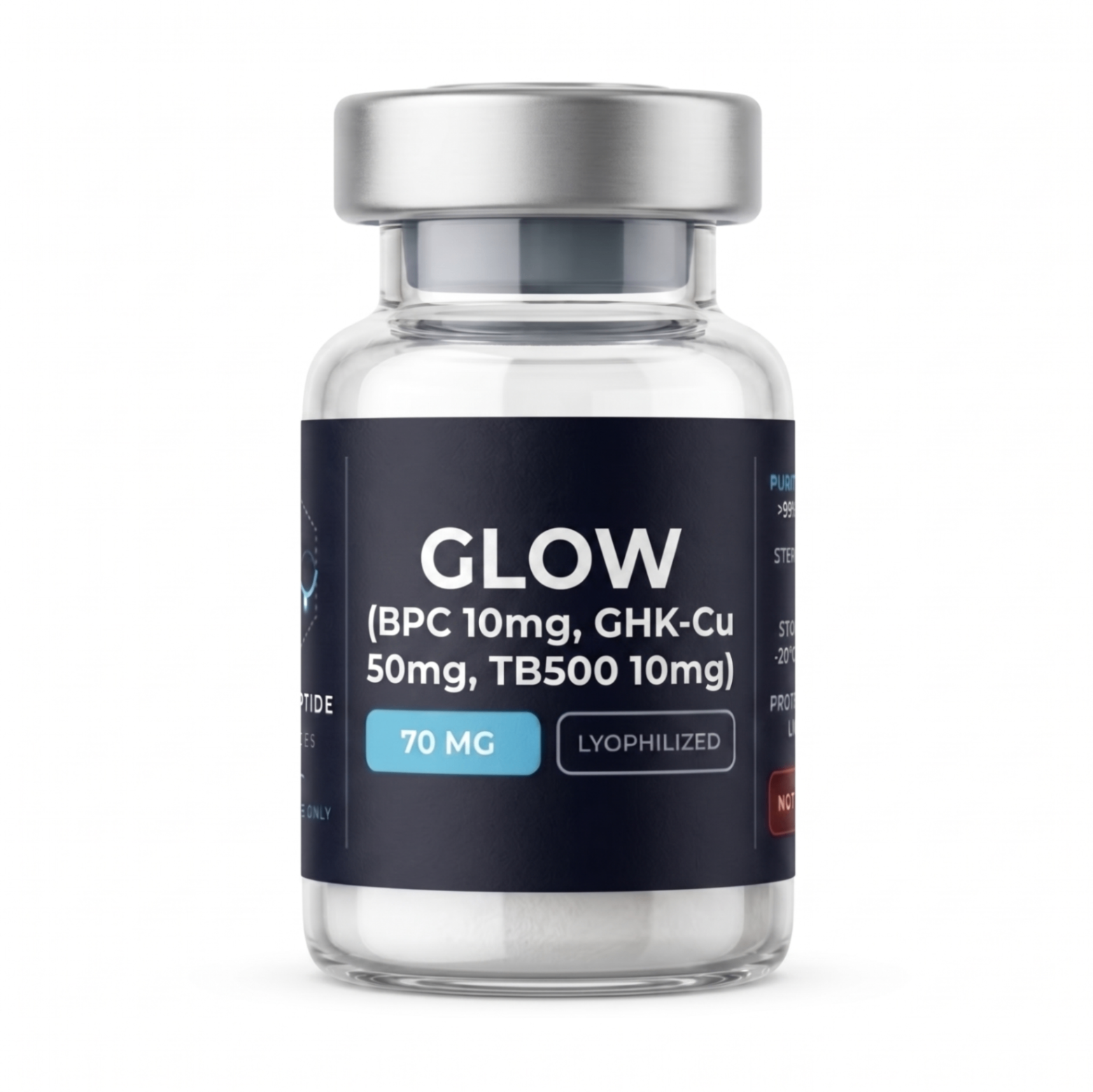
GLOW
Three-peptide skin and connective-tissue stack. BPC-157, GHK-Cu, TB-500.
- Improves skin tone, texture, and elasticity.
- Supports hair and scalp health.
- Speeds healing after cosmetic procedures.
Pre-blended cosmetic-recovery cocktail: BPC-157 10 mg, GHK-Cu 50 mg, TB-500 10 mg in one vial. Optimized for skin remodeling, hair, and visible tissue quality.
GLOW combines the three peptides most studied for skin and connective tissue. GHK-Cu carries copper into fibroblasts and upregulates collagen and elastin. BPC-157 drives microvasculature into the dermis. TB-500 supports the cellular migration phase of remodeling.
- 10.2 mL subcutaneous, once daily for 4–6 weeks.
- 2Maintenance: 2–3× weekly. Rotate injection sites.
- Reconstitution
- 2 mL bacteriostatic water into the blended vial → working stock per label.
- Typical research dose
- Reference 0.1–0.2 mL per administration of the reconstituted blend.
- Frequency
- Once daily, subcutaneous — skin / connective-tissue research framing.
- Vial duration
- A blended vial typically lasts ~20–30 days at 0.1 mL/day and ~10–15 days at 0.2 mL/day — kept inside the 30-day reconstituted-use window.
- Storage
- Refrigerate 2–8 °C; use within 30 days reconstituted.
- GHK-Cu / BPC-157 / TB-500 family — refer to the lot label for component mass.
Understanding GLOW
Skin-first recovery blend
Written for people new to peptides. Clear language, careful claims, no dosing instructions.
+What is GLOW?
GLOW is a research blend focused on skin, collagen, and surface recovery. It typically combines GHK-Cu with BPC-157 and other connective-tissue peptides in a single vial.
It is positioned as a more cosmetic-leaning relative of KLOW.
+How GLOW was discovered
GLOW followed the KLOW model — a single-vial research blend, this time weighted toward skin and surface-recovery endpoints rather than deep tissue. It became widely referenced in dermatology-leaning research stacks during the late 2010s and 2020s.
+How GLOW works in the body
- GHK-Cu drives copper-dependent collagen and elastin synthesis, supports antioxidant gene activity, and improves the appearance of skin in research models.
- The added repair-peptide components reinforce angiogenesis and fibroblast activity for the dermal layer.
+Benefits
- Improves skin tone, texture, and elasticity.
- Supports hair and scalp health.
- Speeds healing after cosmetic procedures.
+Research highlights
GHK-Cu has a substantial published evidence base in dermatology research — wound healing, skin remodeling, and gene-expression studies in fibroblasts. The blend format is community-developed rather than formally trialed.
+What researchers commonly report
Smoother skin texture, improved tone and gradual changes in fine-line appearance are commonly reported.
+Why researchers find GLOW interesting
GLOW is interesting as a 'dermatology-first' research blend — it is one of the only single-vial preparations specifically weighted toward skin endpoints rather than systemic recovery.
+Quality markers we look for
- HPLC purity reviewed with a target of ≥99%
- Mass spectrometry identity confirmation
- LAL endotoxin screening on applicable batches
- Lyophilized (freeze-dried) format for stability
- Careful storage and handling — keep cold, reconstitute with sterile water
+Often paired with
The data your lab notebook needs.
Pulled from the verification packet included with each shipment. Cross-check the batch ID on your vial against the COA.
- Composition
- BPC-157 10 mg · GHK-Cu 50 mg · TB-500 10 mg
- Total Mass
- 70 mg per vial
- Purity
- 99%+ HPLC per component
- Application
- Skin & connective tissue research
- Purity
- Not yet published
- Source
- Not yet published
- Storage
- Lyophilized: 2–8 °C. Reconstituted: 2–8 °C, use within 21 days.
- Reconstitution
- Add 2 mL bacteriostatic water to the blend vial.
- Half-life
- Mixed: hours per component