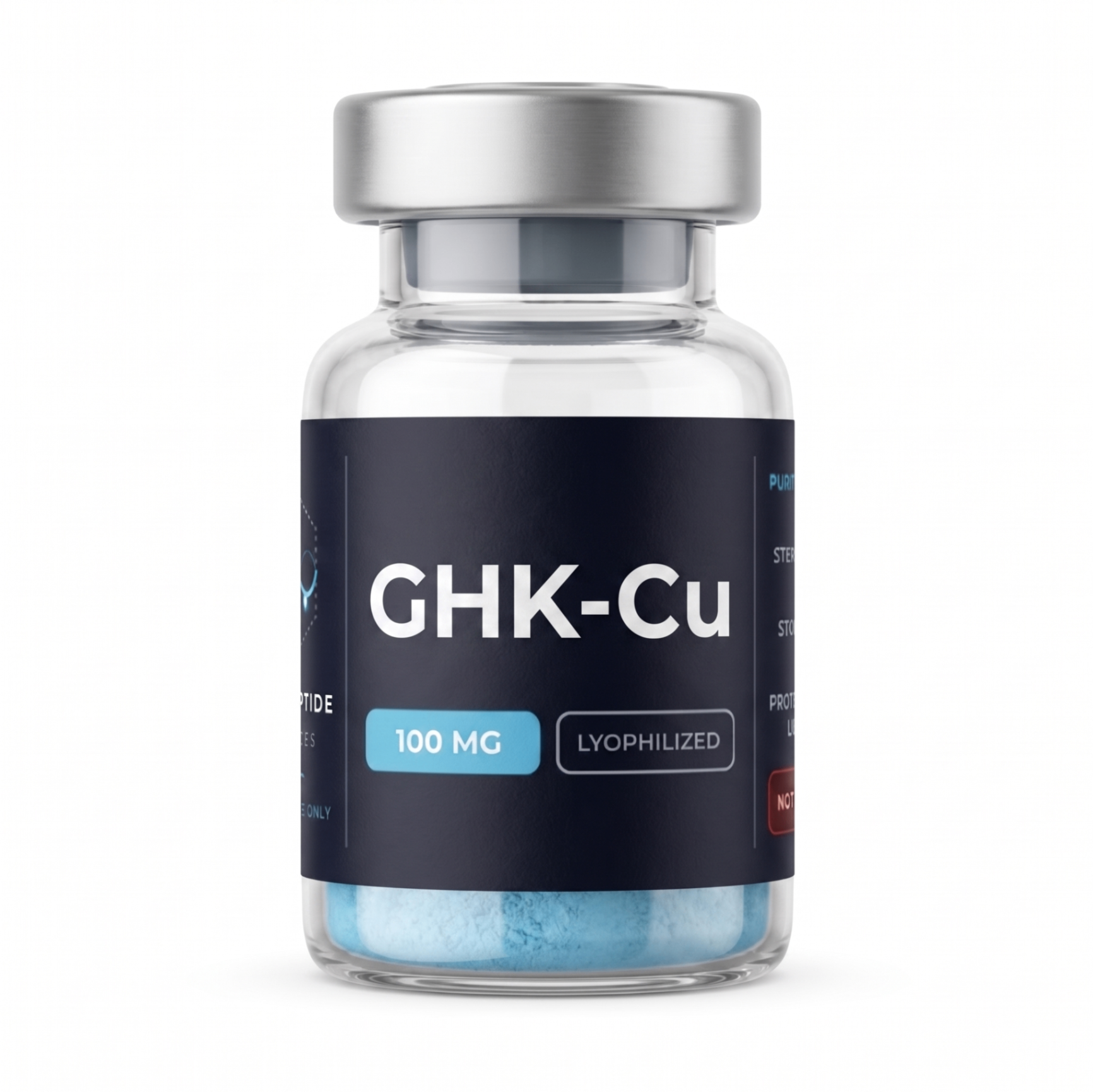
GHK-Cu
Copper tripeptide. Skin, scalp, and connective-tissue research.
- Boosts collagen, elastin, and connective tissue for firmer skin.
- Improves skin tone and overall quality.
- Supports hair and scalp health.
- Boosts antioxidant activity and DNA repair.
Naturally occurring copper-binding tripeptide that drops in plasma after age 60.
GHK-Cu is a copper-bound tripeptide found endogenously in plasma. It upregulates over 4,000 genes associated with tissue maintenance.
- 12–5 mg subcutaneous, once daily, 5 days per week (2 days off).
- 2Rotate injection sites; protect reconstituted solution from light.
- Reconstitution
- 5 mL bacteriostatic water into a 100 mg vial → 20 mg/mL (each 0.1 mL = 2 mg).
- Typical research dose
- Commonly referenced at 2–5 mg per administration, subcutaneous.
- Frequency
- Once daily, 5 days per week (2 days off).
- Vial duration
- A 100 mg vial covers ~4 weeks of dosing at 5 mg/day (5 days/wk = 25 mg/wk). At 2 mg/day (5 days/wk = 10 mg/wk) the raw math reaches ~10 weeks, exceeding the 30-day reconstituted window — reconstitute the vial in halves (50 mg each) so each prep is used within its 30-day window.
- Storage
- Refrigerate 2–8 °C; use within 30 days reconstituted. Protect from light — solution is naturally blue and oxidation darkens it.
- Rotate subcutaneous injection sites to minimize local irritation.
- Topical research preparations exist but the SC reference above is the standard injectable protocol.
Understanding GHK-Cu
The copper peptide behind firmer, younger-looking skin
Written for people new to peptides. Clear language, careful claims, no dosing instructions.
+What is GHK-Cu?
GHK-Cu is a naturally occurring tripeptide (glycyl-L-histidyl-L-lysine) that binds a single copper ion. Levels in human plasma decline meaningfully with age, and most of its claimed effects relate to restoring that signal.
It is one of the most-cited peptides in dermatology and connective-tissue research, with thousands of published papers across cosmetic and wound-healing applications.
+How GHK-Cu was discovered
GHK was first isolated in 1973 by Loren Pickart in human plasma as a factor that enabled aged liver tissue to behave like younger tissue in culture. Its copper-binding form, GHK-Cu, was characterized over the following decade and became one of the most-cited small peptides in dermatology and tissue-repair literature.
Plasma levels of GHK fall meaningfully with age (~200 ng/mL at age 20 to ~80 ng/mL by age 60), which is one of the main framings for why its restoration is researched.
+How GHK-Cu works in the body
- GHK-Cu adjusts the activity of dozens of genes involved in tissue remodeling — gene-array studies have found it influences ~30% of human genes, with the most pronounced effects on collagen, elastin, glycosaminoglycan and antioxidant pathways.
- It supports fibroblast activity and new blood-vessel formation, which translates to skin, hair, and connective-tissue effects.
- It also acts as a small-molecule chelator that can shuttle copper into cells where it is needed for healing — copper is essential for several wound-repair enzymes.
+Benefits
- Boosts collagen, elastin, and connective tissue for firmer skin.
- Improves skin tone and overall quality.
- Supports hair and scalp health.
- Boosts antioxidant activity and DNA repair.
+Research highlights
GHK-Cu has one of the largest published datasets of any small peptide in dermatology, with research across wound healing, skin remodeling, hair-follicle biology, and even neurological tissue support.
Main research areas: skin aging and elasticity, chronic wound healing, hair-follicle stimulation, copper trafficking, and broader effects on gene activity.
Compared with TB-500 it works by changing gene activity rather than cytoskeletal mechanics — different angle on the same overall tissue-repair question.
+What researchers commonly report
Improvements in skin tone, smoother texture, and gradual changes in fine-line appearance are common over multi-week protocols. The reconstituted solution is naturally blue from the copper.
+Why researchers find GHK-Cu interesting
GHK-Cu is interesting because it appears to act as a 'tissue-remodeling switch' at the gene-activity level rather than at a single receptor. That is why its effects span skin, hair, wounds, and connective tissue without needing a separate mechanism for each.
+Quality markers we look for
- HPLC purity reviewed with a target of ≥99%
- Mass spectrometry identity confirmation
- LAL endotoxin screening on applicable batches
- Lyophilized (freeze-dried) format for stability
- Careful storage and handling — keep cold, reconstitute with sterile water
+Often paired with
The data your lab notebook needs.
Pulled from the verification packet included with each shipment. Cross-check the batch ID on your vial against the COA.
- Molecular Weight
- 340.85 g/mol (Cu-bound)
- Sequence
- Gly-His-Lys + Cu²⁺ (3 AA)
- CAS Number
- 89030-95-5
- Synonyms
- Copper tripeptide-1, GHK-Copper
- Purity
- 99%+
- Source
- Synthetic
- Storage
- Lyophilized: room temp. Reconstituted: 2–8 °C, use within 30 days.
- Reconstitution
- Add 5 mL bacteriostatic water to the 100 mg vial. Each 0.1 mL = 2 mg.
- Half-life
- ~2 hours subcutaneous