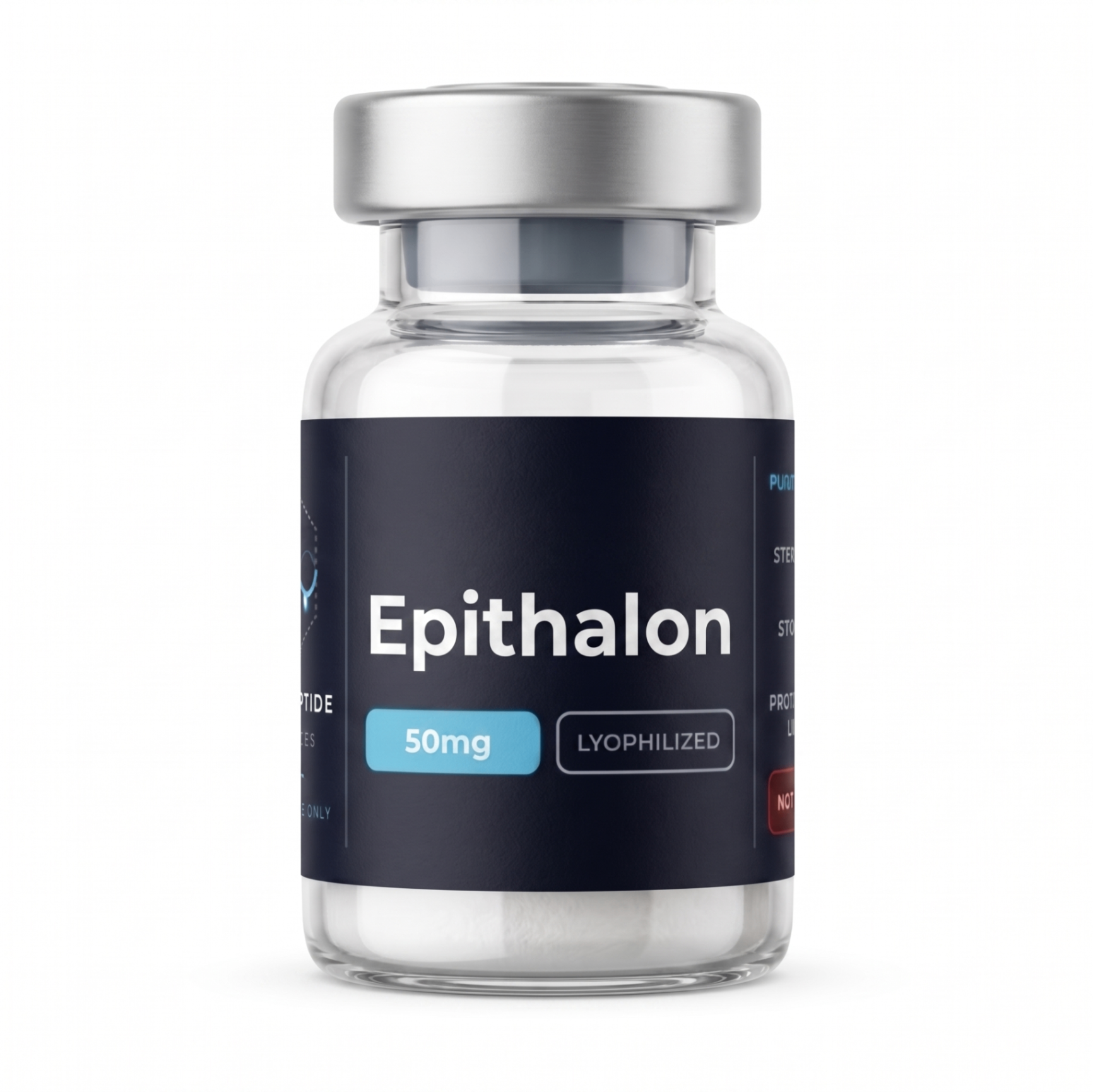
Epithalon
Tetrapeptide telomerase modulator. Russian longevity research staple.
- Supports telomere health and slows cellular aging.
- Improves sleep quality.
- Boosts antioxidant defenses and stress resilience.
- Used in short cycles, just a few times a year.
Synthetic version of Epithalamin, isolated from pineal extract. Long-running Russian gerontology data suggests telomerase upregulation.
Epithalon (Ala-Glu-Asp-Gly) is the synthetic peptide form of Epithalamin. The St. Petersburg cohort data is among the most extensive longevity datasets for any peptide.
- 15–10 mg subcutaneous, once daily, for a 10–20 day cycle.
- 2Repeat the cycle 1–2× per year in longevity-research framing.
- Reconstitution
- 5 mL bacteriostatic water into a 50 mg vial → 10 mg/mL (each 0.5 mL = 5 mg).
- Typical research dose
- Reference 5–10 mg per day.
- Frequency
- Once daily, subcutaneous, for a 10–20 day cycle — commonly repeated quarterly in longevity research.
- Vial duration
- A 50 mg vial covers a single 10-day cycle at 5 mg/day or a single 5-day cycle at 10 mg/day — both inside the 30-day reconstituted-use window.
- Storage
- Refrigerate 2–8 °C; use within 30 days reconstituted.
Understanding Epithalon
The original longevity peptide
Written for people new to peptides. Clear language, careful claims, no dosing instructions.
+What is Epithalon?
Epithalon (Epitalon) is a short, four-amino-acid peptide first isolated from extracts of the pineal gland. It is one of the original Russian-research peptides in the longevity space.
Its claim to fame is its association with telomerase — the enzyme that maintains the protective caps on the ends of chromosomes — and its long-running use in pineal/circadian research.
+How Epithalon was discovered
Epithalon (Ala-Glu-Asp-Gly) was developed in the 1980s by Vladimir Khavinson and colleagues at the St. Petersburg Institute of Bioregulation and Gerontology as a synthetic analogue of epithalamin — a peptide complex extracted from pineal-gland tissue.
Khavinson's group reported the now-famous long-term cohort studies in elderly patients that put Epithalon on the longevity-research map. Most of the published evidence base is Russian-language and Eastern European; Western controlled trials remain limited.
+How Epithalon works in the body
- Epithalon is reported to upregulate telomerase activity, which helps maintain telomere length during cell division — one of the few small peptides described as doing this directly.
- It also appears to support pineal-gland function and melatonin rhythm, which is why it is so often discussed alongside sleep and circadian topics.
- Animal work has reported antioxidant and stress-resilience effects, with downstream consequences on age-related markers.
+Benefits
- Supports telomere health and slows cellular aging.
- Improves sleep quality.
- Boosts antioxidant defenses and stress resilience.
- Used in short cycles, just a few times a year.
+Research highlights
Most published Epithalon work comes from long-running Russian and Eastern European research groups — including multi-year cohort studies on age-related markers and survival.
Main research areas: telomerase regulation, pineal-melatonin restoration, age-related sleep degradation, and oxidative-stress endpoints.
Western controlled human data is limited, which is the most-cited caveat when discussing the molecule.
+What researchers commonly report
Deeper sleep and more vivid dreams are the most consistent anecdotal reports, often noticed early in a protocol. Effects on energy and mood are also commonly described.
+Why researchers find Epithalon interesting
Epithalon is one of very few small synthetic peptides linked directly to telomerase regulation — a mechanism that puts it in an entirely different conceptual bucket from the GH-related and recovery peptides.
+Quality markers we look for
- HPLC purity reviewed with a target of ≥99%
- Mass spectrometry identity confirmation
- LAL endotoxin screening on applicable batches
- Lyophilized (freeze-dried) format for stability
- Careful storage and handling — keep cold, reconstitute with sterile water
+Often paired with
The data your lab notebook needs.
Pulled from the verification packet included with each shipment. Cross-check the batch ID on your vial against the COA.
- Molecular Weight
- 390.35 g/mol
- Sequence
- Ala-Glu-Asp-Gly (4 AA)
- CAS Number
- 307297-39-8
- Synonyms
- Epitalon, AEDG
- Purity
- 99%+
- Source
- Synthetic
- Storage
- Lyophilized: room temp. Reconstituted: 2–8 °C, use within 14 days.
- Reconstitution
- Add 5 mL bacteriostatic water to the 50 mg vial. Each 0.5 mL = 5 mg.
- Half-life
- ~30 minutes (effects cumulative)