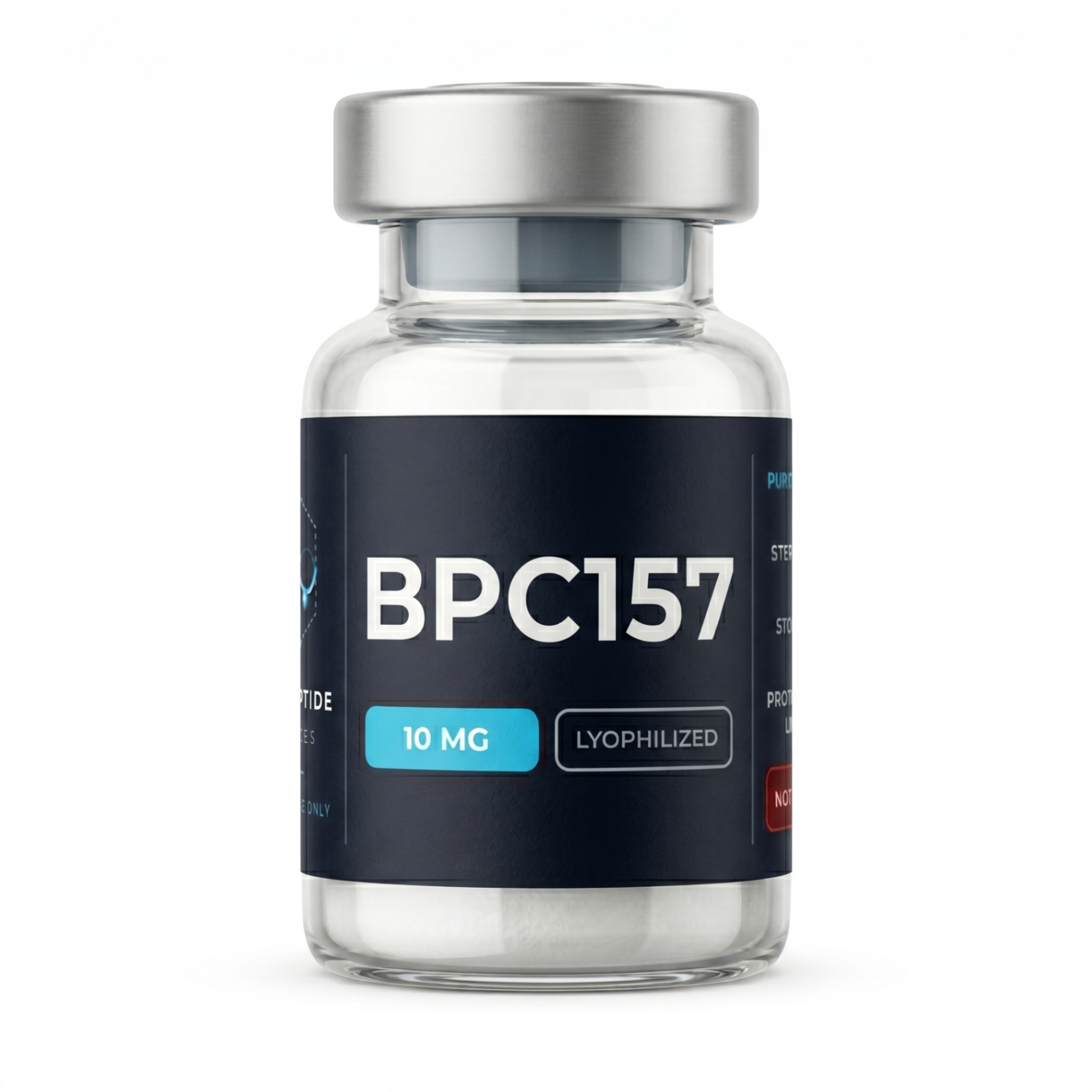
BPC-157
Body Protection Compound. The default systemic-repair peptide.
- Speeds repair of tendons, ligaments, and pulled muscles.
- Supports gut lining and digestive comfort.
- Eases joint discomfort during heavy training.
- Supports nerve tissue recovery.
15-amino-acid fragment from gastric juice BPC. Promotes angiogenesis at injury sites and accelerates tendon-to-bone healing.
BPC-157 is a partial sequence of body protection compound. It upregulates VEGFR2 and promotes microvascular formation around damaged tissue.
- 1250 mcg subcutaneous near the area of interest, 1–2× daily.
- 2Loading phase: 2–4 weeks daily; maintenance: 2–3× weekly.
- 3Rotate injection sites.
- Reconstitution
- 2 mL bacteriostatic water into a 10 mg vial → 5 mg/mL (each 0.05 mL = 250 mcg).
- Typical research dose
- Reference 250–500 mcg per administration.
- Frequency
- 1–2× daily, subcutaneous — commonly placed near the site of interest in research models.
- Vial duration
- A 10 mg vial covers ~20 days at 500 mcg/day and ~10 days at 1000 mcg/day (2× 500 mcg). At 250 mcg/day the raw math reaches ~40 days, exceeding the 30-day reconstituted window — reconstitute the vial in halves (5 mg each).
- Storage
- Refrigerate 2–8 °C; use within 30 days reconstituted.
Understanding BPC-157
The go-to peptide for healing and recovery
Written for people new to peptides. Clear language, careful claims, no dosing instructions.
+What is BPC-157?
BPC-157 is a stable fragment of a larger protein found in human gastric juice. The 'body protection' name comes from how broadly it acts on tissue repair — gut lining, tendons, ligaments, muscle, nerves, and blood vessels.
It is one of the most-discussed peptides in recovery and injury research, especially for soft-tissue and gut applications.
The pentadecapeptide is stable in stomach acid, which is why oral routes are also studied in addition to subcutaneous.
+How BPC-157 was discovered
BPC-157 was first described in the early 1990s by Predrag Sikiric's group at the University of Zagreb, where it was isolated as a stable fragment of a larger 'gastric body protection' protein. The Zagreb group has produced most of the foundational pharmacology literature on the peptide.
Interest in BPC-157 outside academic gastroenterology grew sharply in the 2010s as performance and recovery researchers noticed its broad effects on soft-tissue repair — making it one of the most-discussed recovery peptides in the modern catalog.
+How BPC-157 works in the body
- BPC-157 promotes angiogenesis — the formation of new blood vessels — at sites of injury, which improves blood flow and nutrient delivery to healing tissue.
- It adjusts growth-factor signaling (VEGF, FGF) and supports fibroblast activity, which is central to tendon, ligament and gut-lining repair.
- It influences the nitric-oxide (NO) system and the dopaminergic and serotonergic systems, which is why anti-inflammatory and gut-brain effects also appear in the literature.
+Benefits
- Speeds repair of tendons, ligaments, and pulled muscles.
- Supports gut lining and digestive comfort.
- Eases joint discomfort during heavy training.
- Supports nerve tissue recovery.
+Research highlights
Extensive animal research from the Zagreb group and others supports BPC-157's tissue-repair profile across tendon, ligament, gut, muscle, bone, and even cardiovascular models.
Main areas of active research interest: tendon and ligament repair, inflammatory bowel disease, traumatic-brain-injury recovery, and stress-related GI ulceration.
Controlled human data is more limited, which is why it remains a research-use compound in most jurisdictions — the gap between animal and human evidence is its most-cited limitation.
+What researchers commonly report
Faster resolution of nagging tendon issues, reduced gut discomfort, and improved tolerance of training loads are the most common anecdotal reports. Researchers commonly notice effects within the first 2–3 weeks of a protocol.
+Why researchers find BPC-157 interesting
BPC-157 is interesting because it appears to act 'systemically wherever it's needed' rather than at a single receptor — it is one of the few peptides whose effects don't track to a clean target/pathway diagram, which is exactly why so much research is still being done on it.
+Quality markers we look for
- HPLC purity reviewed with a target of ≥99%
- Mass spectrometry identity confirmation
- LAL endotoxin screening on applicable batches
- Lyophilized (freeze-dried) format for stability
- Careful storage and handling — keep cold, reconstitute with sterile water
+Often paired with
The data your lab notebook needs.
Pulled from the verification packet included with each shipment. Cross-check the batch ID on your vial against the COA.
- Molecular Weight
- 1419.55 g/mol
- Sequence Length
- 15 amino acids
- CAS Number
- 137525-51-0
- Synonyms
- Body Protection Compound 157, PL 14736
- Purity
- 99%+
- Source
- Synthetic
- Storage
- Lyophilized: room temp. Reconstituted: 2–8 °C, use within 30 days.
- Reconstitution
- Add 2 mL bacteriostatic water to the 10 mg vial. Each 0.05 mL = 250 mcg.
- Half-life
- ~4 hours